
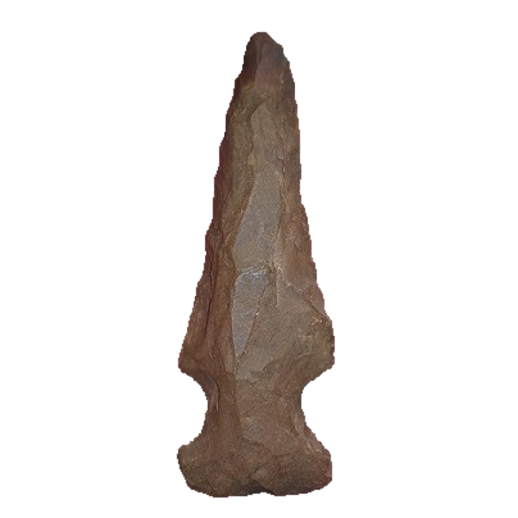
Arrowhead type
Big Sandy Side Notch Point
Big Sandy Side NotchLarge Side Notch Cluster10,000 - 8,000,B.P.Middle Woodland35 reference photos
Key facts
- Age
- 10,000 - 8,000,B.P.
- Cultural period
- Middle Woodland
- Size
- Medium to Large
- Shape
- Side Notch
- Glacial period
- Early Holocene
More from the Woodland period
Description
This triangular side notch point typically measures between 2.25 and 2.75 inches in length, exhibiting a range of cross-sectional profiles, including elliptical, flattened, rhomboid, and medial ridge configurations. The blade morphology varies from excurvate to straight, with some specimens featuring beveled or serrated edges. The shoulders are characterized by straight alignments, while the stem is expanded, providing a sturdy base. The basal morphology is predominantly straight, although some examples display slight convexity or concavity. The point's manufacture involves primary percussion flaking, supplemented by pressure flaking along the edges to achieve a refined finish. The dominant flaking pattern is random, although a small number of specimens exhibit oblique transverse flaking, adding to the point's technical and typological complexity.
Size
The arrowheads exhibit the following dimensional characteristics: their overall length ranges from 35 to 80 mm, with a typical average length of 40 to 50 mm. The stem of the arrowhead measures between 10 to 20 mm in length. In terms of width, the blade spans 18 to 20 mm, while the neck width varies from 13 to 24 mm. The width of the stem is roughly equivalent to that of the shoulders. The thickness of the arrowhead is between 6 to 8 mm.
Distribution
These artifacts are predominantly concentrated in the Tennessee River valley and exhibit a notably high occurrence in the Ohio River Valley. They appear with reduced regularity in the remaining designated regions
Mainly found in
Also found, less often, in
Additional information
The Big Sandy point is a significant artifact in the Side Notched Tradition, representing one of the earliest examples of side-notched points. Notably, its timeline overlaps with that of the Dalton points, highlighting the complex and dynamic nature of early archaeological developments. A closer examination of the Big Sandy points reveals a distinct evolutionary trajectory, with three primary examples showcasing variations in form and morphology. The earliest Big Sandy points are characterized by their smaller size, which is often attributed to the re-sharpening of Graham Cave points, demonstrating the resourcefulness and adaptability of early Native American cultures.
As the Big Sandy point evolves, notable changes emerge in its morphology. The middle points exhibit rounder bases, while the later points are distinguished by their longer stems and more pronounced ears. It is essential to distinguish between the "true" Big Sandy points, which are firmly rooted in the Early Archaic period, and other points that have been incorrectly classified under this category. Many points from the Middle to Late Archaic periods, such as the Godar and Raddatz types, have been misattributed to the Big Sandy classification. In contrast, the authentic Big Sandy points are recognizable by their thin cross-section, less square base, and distinctive eared morphology, often accompanied by an incurvate base. Furthermore, these points frequently exhibit serration, ranging from coarse to fine, and display fine retouch flaking, underscoring the sophistication and craftsmanship of their creators.
The accurate identification and classification of Big Sandy points are crucial for understanding the technological and cultural developments of early Native American societies. By recognizing the unique characteristics of these points, including their morphological variations and technological attributes, archaeologists can gain valuable insights into the lives and traditions of these ancient cultures. The Big Sandy point serves as a testament to the ingenuity and adaptability of early Native American peoples, highlighting the importance of careful analysis and classification in unraveling the complexities of human history.
Identified by
- Named by
- Madeline Kneberg
- Year
- 1956
- Type site
- Big Sandy Site, Henry County, Tennessee
Similar types
Types that are easy to confuse with the Big Sandy Side Notch point.
- Black Sand
- Bolen
- Cache River
- Ensor
- Fairland
- Frio
- Godar
- Graham Cave
- Hickory Ridge
- Kessell
- Newton Falls
- Osceola
- Raddatz
- Rowan
- Savage Cave
- Taylor Side Notch
Other types in the Large Side Notch Cluster
- Big Sandy Broad Base
- Big Sandy Constricted Base
- Big Sandy Leighton Base
- Big Sandy E-Notch
- Greenbrier
- Hemphill
- Howard County
- Madison Side Notched
- Osceola Greenbrier
- Simonsen