
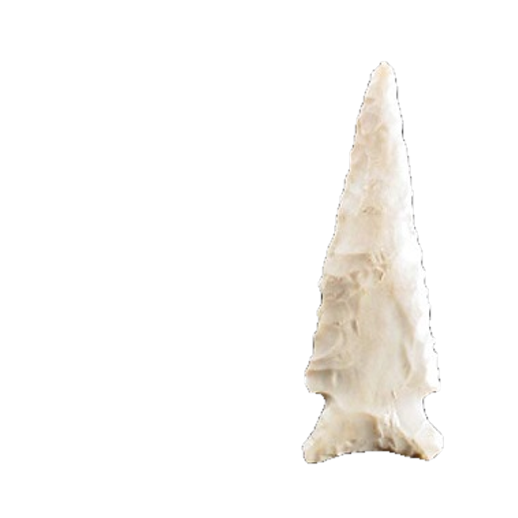
Arrowhead type
Fairland Point
Fairland3,000 - 1,500 B.P.Woodland21 reference photos
Key facts
- Age
- 3,000 - 1,500 B.P.
- Cultural period
- Woodland
- Size
- Small to Medium
- Shape
- Expanding Stem to Corner Notch
- Material
- Limestone
- Glacial period
- Neoglacial to Roman Warm
More from the Woodland period
Description
This triangular point, typically measuring between 1.5 to 2.5 inches in length, exhibits an elliptical cross-sectional profile. Its blade morphology varies, ranging from excurvate to straight, and often features fine serrations, with beveling being a rare occurrence. The shoulders of the point can display a range of orientations, from horizontal to upwardly angled, although barbing is uncommon. Characteristically, the stem expands to a width comparable to that of the shoulders, frequently accompanied by grinding on the basal and hafting regions. The base of the point is distinguished by fine chipping, resulting in a thin, concave profile with sharp auricles and pronounced basal corners. The flaking pattern observed on this point is random, with no discernible order or organization.
Size
The dimensions of the arrowheads are characterized by the following measurements: - Total length ranges from 41 to 100 mm, with an average length of 45 mm. - The stem length varies between 10 and 13 mm, averaging 12 mm, which typically constitutes between 1/5 and 1/2 of the overall length. - The blade width spans 23 to 38 mm, with a mean width of 28 mm. - The neck width falls within the range of 15 to 25 mm, averaging between 18 and 23 mm. - The stem width measures between 21 and 33 mm, with an average of 26 mm. - The thickness of the arrowheads ranges from 8 to 13 mm.
Distribution
This style is mainly located in the heart of Texas and extends into the northeastern parts of Chihuahua, northern Nuevo Leon, and northern Tamaulipas. It is frequently discovered, although its occurrence decreases as you move into western Louisiana, southwestern Arkansas, and southern Oklahoma. (red). Some expert sources have also identified this style in the Tennessee River Valley and the other regions highlighted in yellow.
Additional information
In the realm of Native American arrowhead typology, the Fairland point presents a notable case of similarity with the Edgewood type, making differentiation a challenging task. Both types exhibit comparable distribution patterns and temporal frameworks, which can lead to confusion in identification. A key distinguishing feature, although not absolute, lies in the size of the points: Edgewood points tend to be smaller, typically ranging from 30 to 50 mm in length, whereas Fairland points are generally longer, measuring between 41 to 70 mm. Additionally, while the width of both types may be similar, the broader proportions of Edgewood points set them apart from the more slender Fairland points.
The complexity of distinguishing between these two types is further underscored by the observations of Suhm and Krieger (1954), who suggested that the examples they provided for Edgewood points may, in fact, include Fairland points, and vice versa. This overlap highlights the difficulties inherent in categorizing these arrowhead types, leading some to argue that Edgewood and Fairland may represent a single, rather than distinct, typological categories.
The Fairland point can also be confused with the Darl point, another type that requires careful consideration for accurate identification. A primary characteristic that differentiates the Fairland point from the Darl point is the width and beveling of the blade. The Darl point is typically wider and exhibits beveling, whereas the Fairland point has a narrower blade with no beveling present, as noted by Johnson et al. (2002). These subtle differences are crucial for archaeologists seeking to accurately classify and understand the significance of these artifacts within their cultural and historical contexts.
Identified by
- Named by
- J. Charles Kelly
- Year
- 1947
- Type site
- Lehmann Rock Shelter, Gillespie County, Texas
Similar types
Types that are easy to confuse with the Fairland point.