
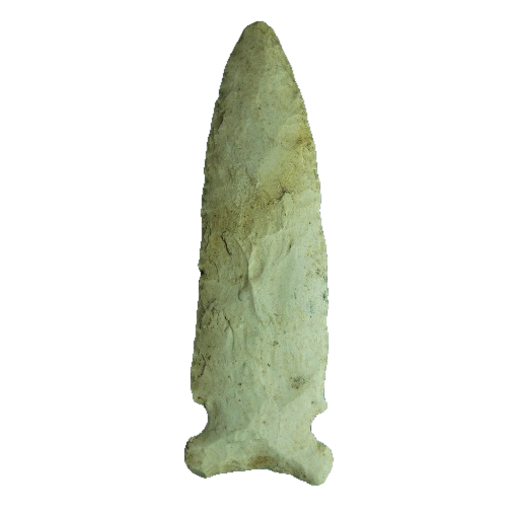
Arrowhead type
Osceola Point
OsceolaLarge Side Notch Cluster4,000 - 2,500 B.P.Late Archaic to Early Woodland14 reference photos
Key facts
- Age
- 4,000 - 2,500 B.P.
- Cultural period
- Late Archaic to Early Woodland
- Culture
- Old Copper Culture
- Size
- Medium to Large
- Shape
- Side Notch
- Material
- Copper
- Glacial period
- Neoglacial
Description
This side-notched point typically measures between 4 to 5 inches in length, characterized by a cross-sectional profile that ranges from flattened to elliptical. The blade itself is elongated and slender, often exhibiting an excurvate shape, although heavily resharpened specimens may display a straight or recurvate configuration. In instances where the blade is particularly long, the edges may run parallel to each other. Notable for its deep, wide notches that are positioned low on the blade, this point features notches with shapes spanning from rounded to square, accompanied by basal ears that conform to the blade's curvature. The stem is broadened, usually matching the blade's width, and maintains a seamless continuity with the blade's overall silhouette. The base of the point can vary, most commonly presenting a concave shape, but also occasionally appearing straight. The basal auricles, or ears, are either squared or rounded, distinguishing them from the sharper, more pointed features of the Graham Cave point. Any basal grinding present is typically minimal. The manufacturing process involves large random percussion flaking, supplemented by marginal pressure flaking to refine the blade, resulting in a random flaking pattern that underscores the point's high level of craftsmanship, evident in most examples.
Size
The arrowheads exhibit a range of dimensions, with overall lengths spanning from 68 mm to 230 mm, and an average length of 115 mm. The width of the blade varies between 29 mm and 47 mm, with a mean width of 35 mm. In terms of thickness, the measurements fall within a range of 5 mm to 10 mm, averaging 7 mm.
Distribution
These artifacts are mainly located in the northern and central regions of the Mississippi River basin, extending into the Ohio, Illinois, and Missouri river basins. They can also be discovered in the Tennessee River basin, albeit less commonly.
Mainly found in
Additional information
The chronology of Osceola points has been a subject of debate among archaeologists, with two distinct time periods proposed. The earliest suggested date range, spanning from 7,000 to 5,000 years before present (B.P.), was put forth by Bell in 1958. However, this timeline has been contested by Justice in 1987, who argues that it is too early for these points. In contrast, Montet-White's 1968 dating of 4,000 to 2,500 B.P. aligns with the Old Copper culture, with which Osceola points are commonly associated. Cambron's research also supports an earlier date, similar to Bell's, based on the points' connection to the Big Sandy complex in the Tennessee River Valley. Nevertheless, Justice's work suggests that Osceola points may not have extended into this region, raising questions about the possibility of two distinct point types being mistakenly classified as one.
A notable aspect of Osceola points is their striking resemblance in outline to Hemphill points found in Illinois. Although similar in shape, the two point types differ significantly in terms of workmanship and age, with Hemphill points being more refined and dating to a later period, approximately 2500 to 1500 B.C.E. According to Goldstein and Osborn's 1988 research, Osceola points share similarities with other point types, including Raddatz, Hemphill, Black Sand, Graham Cave, and Madison Side-Notched points, as noted by Morrow in 2016. This highlights the complexity of arrowhead typology and the need for careful consideration of morphological and chronological characteristics.
The Osceola point's relationship to other point types, such as the Osceola Greenbrier point, has also been a source of confusion. The Osceola Greenbrier point, an Early Archaic point, has been associated with the Osceola point, but its distribution does not overlap with that of the Osceola point or the Old Copper Culture. Furthermore, the variant of the Osceola Greenbrier point with a basal protrusion may represent a transitional point from the Paleo to Archaic period, which would be significantly earlier than the accepted date range for Osceola points. This underscores the importance of precise dating and distribution analysis in understanding the cultural and chronological context of these archaeological artifacts.
Identified by
- Named by
- Robert Ritzenthaler
- Year
- 1946
- Type site
- Osceola Site, Grant County, Wisconsin
Similar types
Types that are easy to confuse with the Osceola point.