
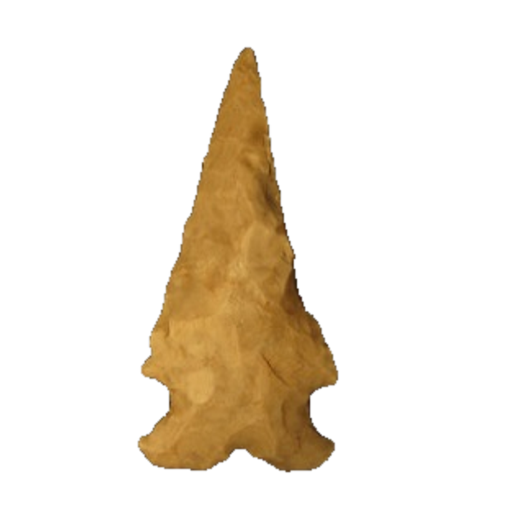
Arrowhead type
Frio Point
Frio2,200 - 1,400 B.P.Transitional Archaic28 reference photos
Key facts
- Age
- 2,200 - 1,400 B.P.
- Cultural period
- Transitional Archaic
- Size
- Small to Medium
- Shape
- Expanding Stem to Bifurcated to Side Notch
- Glacial period
- Roman Warm
More from the Archaic period
Description
This triangular point exhibits a side notch morphology, typically measuring between 1.5 to 2 inches in length, with a distinctive bifurcated stem that expands towards the base. The blade profile is generally straight, although it may exhibit subtle variations, ranging from a slight excurvate curve to a more pronounced incurvate or recurvate shape. The shoulders are predominantly horizontal, but can display minor deviations, including a slight barbing or an upward inclination. The elliptical cross-section is a notable feature of this point. The expanding stem terminates in a recurvate base, often formed by a concave or deeply notched U-shaped configuration. The basal ears are flared, presenting a range of shapes from rounded to squared. The flaking pattern on this point is characterized by a random, non-patterned arrangement of flakes.
Size
The arrowheads exhibit a range of dimensions, with lengths spanning 30 to 70 mm, averaging 50 mm. The stem length varies between 5 and 15 mm, generally accounting for one-sixth to one-third of the overall length. At the shoulders, the width ranges from 20 to 40 mm, while the neck width measures between 14 and 19 mm. The stem width is recorded as 20 to 30 mm, with an average measurement of less than 25 mm.
Distribution
This arrowhead is mainly located from the heart of Texas to the southern Pecos region of Texas, New Mexico, northern Chihuahua, and northern Coahuila. The distribution peaks in the western areas and gradually declines in frequency as it moves eastward. Bell (1958) also situates this type in eastern to central Oklahoma
Mainly found in
Also found, less often, in
Additional information
In the realm of Native American archaeology, the classification of certain arrowhead types has undergone significant refinement over the years. Initially, both Ensor and Frio type points were categorized together as Ensor points, based on discoveries made at the Belton Reservoir by Miller and Jelks. However, a reevaluation by Suhm et al. in 1954 led to a redefinition of the Ensor type, effectively excluding Frio points from this classification. As a result, collector communities often refer to Frio type points associated with Ensor points as either Ensor Split Stem or Ensor Frio points, acknowledging their similarities while also recognizing distinct characteristics.
A closer examination of the Ensor Frio and Frio types reveals notable differences in their morphological features. The Ensor Frio is distinguished by its narrow diagonal notch, accompanied by a slightly barbed shoulder and a recurvate base. In contrast, the Frio type exhibits a wider parallel notch, with a shoulder that is typically angled upward and a base that is either notched or exhibits a V-shaped appearance. Despite these differences, it is essential to recognize that the two types are closely related, and the distinctions between them may represent a continuum rather than a clear-cut dichotomy. This ambiguity has led to the Ensor Frio type not being widely accepted as a distinct type within professional archaeological circles.
The Ensor Frio point is also colloquially known as the "Walking Man point" among collectors, a testament to its unique characteristics and the fascination it has inspired. By examining the nuances of this point type, researchers can gain valuable insights into the technological and cultural developments of the Native American groups that created these artifacts. The study of arrowhead types like the Ensor Frio offers a window into the lives and traditions of these communities, highlighting the importance of continued archaeological research and classification efforts to deepen our understanding of Native American history and culture.
Identified by
- Named by
- Charles J. Kelly
- Year
- 1947
- Type site
- The Lehman Rock Shelter, Gillespie County, Texas
Similar types
Types that are easy to confuse with the Frio point.
- Diablo Corner Notch
- Big Sandy
- Cossatot River
- Ensor Split Base
- Fairland
- Montell
- Paisano
- Pasitas
- Tehuacan
- Tlanalapa
- Todsen
- Uvalde
- Ventana Side Notch