
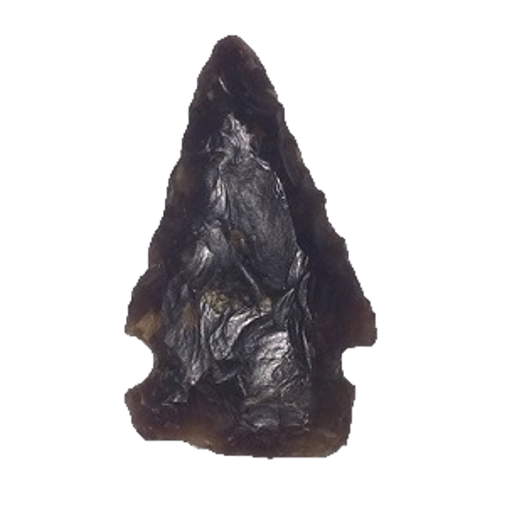
Arrowhead type
Raddatz Point
RaddatzLarge Side Notch Cluster6,100 - 4,300 B.P.Middle Archaic to Late Archaic18 reference photos
Key facts
- Age
- 6,100 - 4,300 B.P.
- Cultural period
- Middle Archaic to Late Archaic
- Size
- Medium
- Shape
- Side Notch
- Material
- Chert
- Glacial period
- Neoglacial
More from the Archaic period
Description
This medium-sized, triangular point features a distinctive elliptical cross-section and exhibits a range of blade profiles, from excurvate to straight, with occasional subtle serrations. Characteristic parallel, U-shaped notches are situated towards the base of the blade. The expanding stem is typically square in shape. Notably, the notches are often cut into the blade, resulting in basal ears that mirror the curvature of the blade itself. The base of the point is generally straight, although it may display a slight concavity, and presents a squarish appearance. Thinning of the base is achieved through the removal of one or more long pressure flakes, and the presence of light to moderate basal grinding is common, although not ubiquitous. The manufacture of this point involves an initial stage of random percussion flaking, followed by a finishing process that employs pressure flaking to create a random, multi-directional flaking pattern.
Size
The arrowheads exhibit a range of dimensions, with overall lengths spanning 33 to 92 mm. The stem, a crucial component, measures between 9 and 15 mm in length. In terms of width, the blade and stem collectively range from 18 to 34 mm, while the neck, a narrower section, varies from 14 to 29 mm. Additionally, the thickness of these artifacts falls within a specific range, from 6 to 11 mm.
Distribution
These artifacts are mainly discovered in the upper Mississippi River Valley and extending into the Illinois and Ohio River basins. They can also be located throughout the Great Lakes area
Additional information
In the realm of Native American arrowheads, a notable comparison can be drawn between the Godar and Raddatz points, both of which exhibit a distinctive excurvate to straight blade morphology. Notably, these points are smaller in size compared to the Osceola points. As observed by Morrow in 2016, the Godar and Raddatz points share essentially identical morphological characteristics, raising questions about the validity of their separate type designations. It can be argued that these designations are more a matter of provincial variation rather than distinct typological differences.
A closer examination of the geographical distribution of these points reveals that medium-sized, side-notched points found in Illinois are typically classified as Godar points, while those discovered in Wisconsin are referred to as Raddatz points. This regional distinction highlights the complexities of categorizing arrowhead types, particularly during the Middle Archaic period. When considering the characteristic shapes of these points, it becomes apparent that there is a degree of variation within each type. However, as the characteristics of individual points deviate from the typical morphology, the boundaries between the Godar and Raddatz types begin to blur, making it increasingly challenging to distinguish between them without considering the broader contextual factors associated with each point.
The overlap between the Godar and Raddatz points underscores the importance of considering the archaeological context in which these artifacts are found. By examining the associated cultural and temporal factors, researchers can gain a more nuanced understanding of the significance and function of these arrowhead types. The study of these points, therefore, serves as a reminder of the complexities and nuances inherent in the classification and interpretation of archaeological artifacts, and the need for a comprehensive and multidisciplinary approach to understanding the cultural and historical contexts in which they were created and used.
Identified by
- Named by
- Warren J. Wittry
- Year
- 1959
- Type site
- Raddatz Rock Shelter, Sauk County, Wisconsin
Similar types
Types that are easy to confuse with the Raddatz point.
Other types in the Large Side Notch Cluster
- Big Sandy
- Cache River
- Godar
- Graham Cave
- Greenbrier
- Hemphill
- Howard County
- Madison Side Notched
- Osceola
- Osceola Greenbrier
- Simonsen