
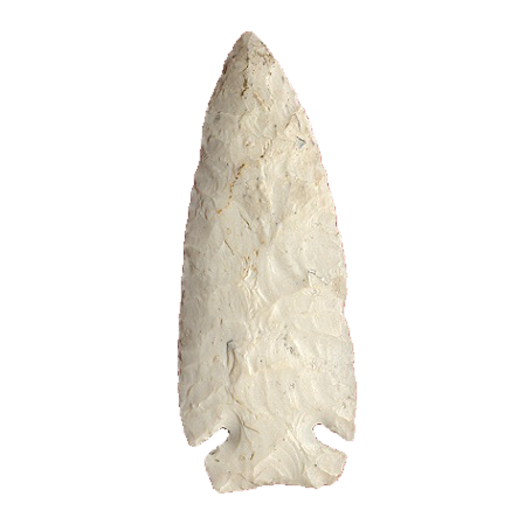
Arrowhead type
Howard County Point
Howard CountyLarge Side Notch Cluster7,500 - 6,500 B.P.Middle Archaic10 reference photos
Key facts
- Age
- 7,500 - 6,500 B.P.
- Cultural period
- Middle Archaic
- Size
- Medium to Large
- Shape
- Side Notch to Bifurcated
- Glacial period
- Middle Holocene
More from the Archaic period
Description
This triangular point exhibits a slender profile with a medium to large size, characterized by a flattened cross-sectional shape. The blade's curvature is predominantly excurvate, although it can occasionally appear straight. Its maximum width is typically situated above the shoulder area. The side notches are diagonally oriented and tend to be narrow, creating a distinctive silhouette. The stem expands outward, forming an expanded shape. The base of the point can vary in shape, ranging from a straight edge to a concave curve, with basal corners that can be either rounded or square in shape. The presence of basal grinding is minimal to nonexistent. The flaking pattern on this point is random, yet it is often meticulously crafted, indicating a high level of manufacturing skill.
Size
The dimensions of the arrowheads are characterized by the following measurements: overall length ranges from 45 to 120 mm, with a mean length typically falling between 60 to 70 mm. The stem measures between 8 to 11 mm in length. In terms of width, the blade spans 21 to 39 mm, while the neck and stem widths are 15 to 24 mm and 21 to 35 mm, respectively.
Distribution
These artifacts are mainly located from middle Missouri to Illinois.
Additional information
In the realm of Native American archaeology, a specific type of arrowhead has been identified and categorized based on its distinctive characteristics. Previously, these artifacts were grouped under the classification of Cache River variant, a designation that reflects their unique attributes and cultural associations. This classification is significant, as it highlights the importance of the Cache River region in the study of Native American archaeology, particularly with regards to the analysis of lithic artifacts such as arrowheads.
The Cache River variant classification is a testament to the meticulous work of archaeologists in identifying and categorizing the diverse array of arrowhead types found in North America. By examining the morphology, material, and context of these artifacts, researchers have been able to reconstruct the technological, social, and cultural practices of the Native American groups that created them. The Cache River variant, in particular, offers valuable insights into the lives and traditions of the indigenous peoples who inhabited the region, providing a window into their hunting practices, trade networks, and cultural exchange.
Through the study of these arrowheads, archaeologists can gain a deeper understanding of the complex and nuanced history of Native American cultures, as well as the significance of the Cache River region in the broader context of North American archaeology. By continuing to analyze and interpret these artifacts, researchers can refine their understanding of the Cache River variant and its place within the larger narrative of Native American archaeology, ultimately shedding new light on the lives and traditions of the indigenous peoples who created these remarkable artifacts.
Identified by
- Named by
- Gregory Perino
- Year
- 1991
Similar types
Types that are easy to confuse with the Howard County point.
Other types in the Large Side Notch Cluster
- Big Sandy
- Cache River
- Godar
- Graham Cave
- Greenbrier
- Hemphill
- Madison Side Notched
- Osceola
- Osceola Greenbrier
- Raddatz
- Simonsen