
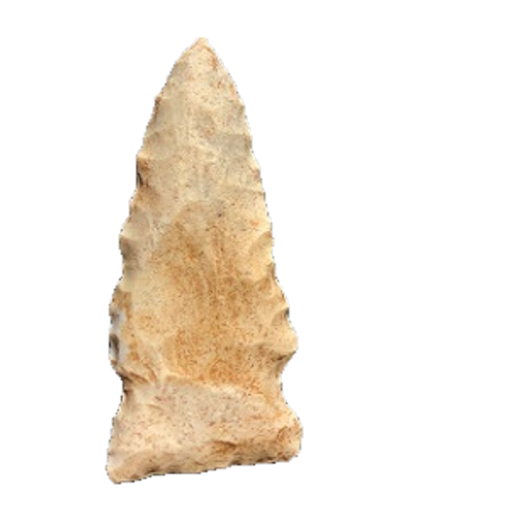
Arrowhead type
Osceola Greenbrier Point
Osceola GreenbrierLarge Side Notch Cluster9,000 - 7,000 B.P.Early Archaic16 reference photos
Key facts
- Age
- 9,000 - 7,000 B.P.
- Cultural period
- Early Archaic
- Size
- Medium to Large
- Shape
- Side Notch
- Glacial period
- Early to Middle Holocene
More from the Archaic period
Description
This triangular side notch point exhibits a medium to large size profile, characterized by a cross-sectional shape that ranges from flattened to convex. The blade's curvature is predominantly excurvate, often featuring fine serrations along its edge. The shoulders of the point display variability, with some specimens presenting a horizontal orientation and others exhibiting a gentle upward incline. The stem expands in width, while the base can manifest as either concave or bearing two shallow notches that collectively form a basal nipple. Notably, the hafting area is distinguished by extensive grinding, indicative of deliberate preparation for attachment. The flaking pattern observed on this point is random, lacking a discernible order or sequence.
Size
The dimensions of the arrowheads are as follows: they range in overall length from 30 to 95 mm, with a typical length of 45 to 55 mm. The stem measures between 10 to 15 mm in length. In terms of width, the arrowheads vary from 20 to 40 mm, with an average width of 28 to 34 mm. The neck width ranges from 15 to 25 mm, and the thickness of the arrowheads falls between 5 to 9 mm.
Distribution
This type is located in Florida and extends into the southern regions of Georgia and Alabama.
Also found, less often, in
Additional information
The archaeological community has traditionally referred to a particular type of projectile point as the Osceola Greenbrier, a designation coined by John Powell in 1990. However, this nomenclature has been deemed misleading, as it conflates two distinct point types. A more accurate classification would be the Florida Greenbrier, a term initially introduced by Ripley P. Bullen in 1975. This point type is, in fact, a variant of the Greenbrier point, characterized by a consistent date and distribution that aligns with the broader Greenbrier category.
Notably, the Florida Greenbrier point should not be confused with the Osceola point, which exhibits a different distribution and chronological profile, spanning the Late Archaic to Early Woodland periods. In contrast, the Florida Greenbrier point is an Early Archaic type. The literature also references this point as the Nipple Point, a designation used by avocational archaeologist Frankie Snow in 1980. Furthermore, Whatley's 2002 research groups this point, along with another type, under the Hardaway category. The Union Side Notch point is believed to be a precursor to the Florida Greenbrier, with the Nipple Variant potentially representing an intermediate form. The double-notched base of the Florida Greenbrier point forms a distinctive nipple-like feature, reminiscent of the striking platforms employed in the advanced fluting techniques characteristic of Folsom and Cumberland points. Although no fluted examples of the Florida Greenbrier point have been reported, this similarity raises intriguing questions about its potential status as an early variant within the Greenbrier point tradition.
The Florida Greenbrier point's morphology and technological attributes underscore its significance within the context of Native American archaeology. The presence of a nipple-like feature on the base, formed by the double notching, highlights the point's unique characteristics and its possible connections to other point types. As researchers continue to refine our understanding of the Florida Greenbrier point, its classification and relationships to other point types will remain an important area of study, shedding light on the technological and cultural developments of Early Archaic societies in the region.
Identified by
- Named by
- Ripley P. Bullen
- Year
- 1975
Similar types
Types that are easy to confuse with the Osceola Greenbrier point.
- Bolen
- Dalton Greenbrier
- Hardaway
- Union Side Notch
Other types in the Large Side Notch Cluster
- Big Sandy
- Cache River
- Godar
- Graham Cave
- Greenbrier
- Hemphill
- Howard County
- Madison Side Notched
- Osceola
- Raddatz
- Simonsen