
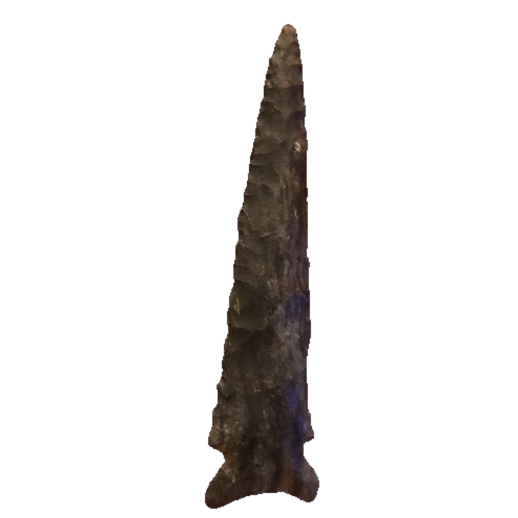
Arrowhead type
Graham Cave Point
Graham CaveLarge Side Notch Cluster10,000 - 7,500 B.P.Early Archaic32 reference photos
Key facts
- Age
- 10,000 - 7,500 B.P.
- Cultural period
- Early Archaic
- Size
- Medium to Large
- Shape
- Side Notch
- Glacial period
- Early Holocene
More from the Archaic period
Description
This side-notched point exhibits a medium to large size profile, characterized by a flattened cross-sectional morphology. The blade itself is elongated and slender, often displaying a range of curvature, from straight to excurvate or incurvate forms. A notable feature of this point is the presence of serrations, typically observed on blades that have undergone re-sharpening. The parallel notches are deeply incised and positioned low on the blade, forming shoulders that can be either horizontal or sloping upward. The stem expands outward, terminating in a concave base that has been subjected to intense basal grinding, resulting in the formation of sharp, basal auricles. The manufacturing process involved broad, random percussion flaking, supplemented by pressure flaking for trimming and edge smoothing. The blade edges also exhibit short, marginal pressure retouch, generating a random flaking pattern. In rare instances, this point type may display fluting, adding to its morphological variability.
Size
The dimensions of the arrowheads are as follows: overall length ranges from 45 to 152 mm, with a typical range of 55 to 70 mm. The stem measures between 10 and 20 mm in length, averaging 15 mm. The blade width varies from 20 to 34 mm, while the neck width spans 13 to 25 mm, typically falling within the range of 15 to 20 mm. Additionally, the stem width is recorded to be between 20 and 35 mm.
Distribution
These artifacts are most abundant in Missouri and Illinois. This type can also be discovered along the upper Mississippi river and its surrounding waterways
Also found, less often, in
Additional information
The archaeological record reveals three distinct variations of this point, each with unique characteristics. The first subtype, denoted as Subtype A, is notable for its elongated shape and precise, small side notches. A distinctive feature of this subtype is its deeply concave base, which is accentuated by basal ears that exhibit a barbed appearance. The blade itself is finely serrated, and in cases where the point has undergone extensive re-sharpening, it may display a recurvate shape. Notably, the cross-section of Subtype A points is typically thick, with an elliptical shape.
In contrast, Subtype B is distinguished by its slender profile and broad blade, which is usually excurvate in shape. This subtype presents a marked difference from Subtype A, particularly in terms of its overall thickness and blade morphology. The third variation, Subtype C, also features an excurvate blade, but is set apart by its round basal ears, as observed by Justice in 1987. A comparative analysis with Osceola points reveals similarities, but also some key differences. Specifically, Osceola points tend to exhibit less refined craftsmanship and typically have a straight to slightly concave base, with notches positioned higher on the blade than those found on Graham Cave points, as noted by Morrow in 2016.
The Graham Cave point, with its three distinct subtypes, offers valuable insights into the technological and stylistic developments of Native American arrowhead manufacture. The variations in basal ear shape, blade morphology, and cross-sectional thickness underscore the complexity and nuance of these ancient tools. Furthermore, the similarities and differences between Graham Cave and Osceola points highlight the importance of careful typological analysis in understanding the cultural and historical contexts of these artifacts. By examining the subtle differences in workmanship, shape, and size, researchers can gain a deeper appreciation for the craftsmanship and traditions of the indigenous cultures that created these remarkable points.
Identified by
- Named by
- Edward G. Scully and Wilfred Logan
- Year
- 1951
- Type site
- Graham Cave Site, Montgomery County, Missouri
Similar types
Types that are easy to confuse with the Graham Cave point.
Other types in the Large Side Notch Cluster
- Big Sandy
- Cache River
- Godar
- Greenbrier
- Hemphill
- Howard County
- Madison Side Notched
- Osceola Greenbrier
- Raddatz
- Simonsen