
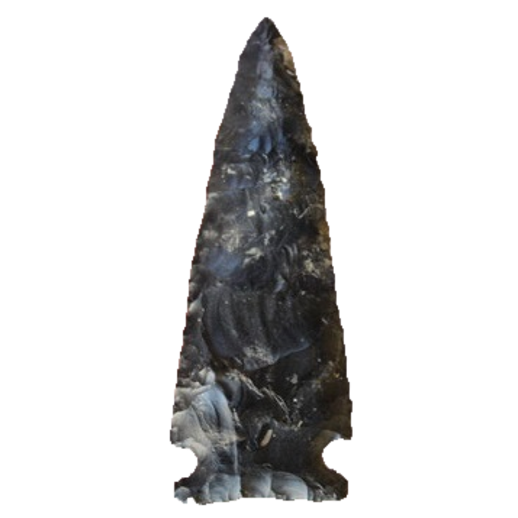
Arrowhead type
Bolen Point
Bolen9,500 - 8,500 B.P.Late Woodland36 reference photos
Key facts
- Age
- 9,500 - 8,500 B.P.
- Cultural period
- Late Woodland
- Size
- Small to Medium
- Shape
- Side Notch to Corner Notch to Expanding Stem
- Material
- Coral
- Glacial period
- Early Holocene
More from the Woodland period
Description
This triangular point exhibits a distinctive morphology, characterized by a side notch configuration and a cross-sectional shape that ranges from flattened to elliptical. The blade profile can vary, displaying either an excurvate or straight alignment, and often features fine serrations along its edge. The shoulder morphology is diverse, spanning from a horizontal orientation to a more pronounced, barbed form. The stem exhibits variability in its width, transitioning from expanding to fully expanded. The basal edge can assume multiple forms, including straight, convex, or, less commonly, slightly concave. Some specimens display evidence of basal grinding, indicating deliberate edge modification. The flaking pattern on this point is random, lacking a consistent or organized arrangement of flake scars.
Size
The dimensions of the arrowheads are characterized by the following measurements: overall length ranges from 33 to 100 mm, with a typical span of 45 to 55 mm. The stem length varies between 9 and 15 mm, commonly measuring around 10 mm. The width of the arrowhead falls within the range of 20 to 40 mm, typically between 28 and 34 mm. Notably, the stem width is generally slightly narrower than the shoulders. In terms of thickness, the arrowheads measure between 5 and 12 mm. These measurements apply to distinct types, including those with Bolen Beveled and Bolen Expanded Notch characteristics.
Distribution
This type is mainly located in northern Florida and extends as far north as Polk, Cobb, Bartow, and Cherokee county Georgia, southeastern Alabama, and eastward into the lower Savannah River Valley of South Carolina. It can also be discovered in central Florida, albeit less often. Additionally, it has been sporadically spotted in the coastal areas of Mississippi and Louisiana.
Mainly found in
Also found, less often, in
Additional information
The Bolen type point, a significant artifact in Native American archaeology, has been extensively studied and categorized by renowned expert Ripley Bullen. Bullen's classification system identifies five distinct variants of the Bolen type point, each with unique characteristics. The Bolen Type 1, for instance, is distinguished by its straight base and side notching, bearing a resemblance to the Big Sandy point, yet is often found in association with other Bolen style points. In contrast, the Bolen Type 2 features a convex base, setting it apart from its Type 1 counterpart.
Further examination of the Bolen type point reveals additional variants, including the Bolen Type 3, which shares similarities with the Kirk Corner Notch, but is notable for its longer stem. The Bolen Type 5, characterized by a large square notch, is formed through the removal of flakes from both the top and bottom of the notch, resulting in an Expanded Notch type. Other notable variants, not identified by Bullen but commonly recognized, include the Bolen E Notch, which features a protrusion at the center of the notch, and the Bolen Ace, an unsharpened Type 2 with a convex base and unbeveled edge, giving it a distinctive "Ace of Shapes" appearance. The Bolen Recurvate, with its recurvate base and concave center, rounds out at the basal corners, adding to the diversity of this point type. It is worth noting that all subtypes of the Bolen point may exhibit either a plain or beveled blade edge.
The classification of the Bolen type point has been subject to some debate, with John Whatley arguing that small Bolen Corner Notch points would be better classified as Bolen type, while larger specimens would be more accurately categorized as Kirk Corner Notch points. This perspective, supported by Lloyd Schroder's research in 2013, highlights the complexities and nuances of arrowhead classification, underscoring the need for ongoing research and refinement in the field of Native American archaeology. By examining the various characteristics and subtypes of the Bolen point, researchers can gain a deeper understanding of the cultural and historical contexts in which these artifacts were created and used.
Identified by
- Named by
- Wilfred T. Neill
- Year
- 1963
- Type site
- Bolen Bluff Site, Florida
Similar types
Types that are easy to confuse with the Bolen point.
- Big Sandy
- Clay
- Hardaway
- Kirk Corner Notch
- Lafayette
- Lost Lake
- Osceola Greenbrier
- Taylor
- Thebes
Other types in this cluster
- Bolen Bevel
- Bolen Extended Notch