
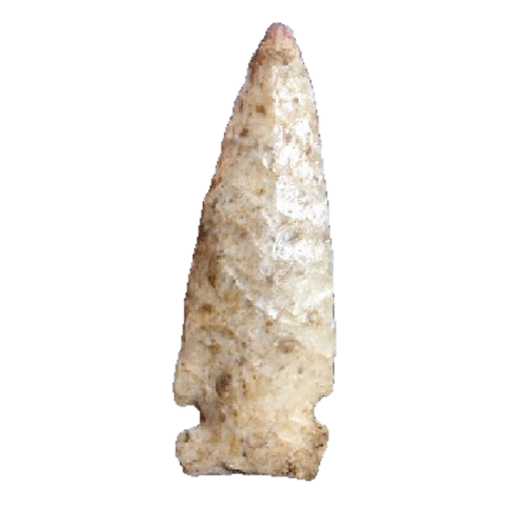
Arrowhead type
Cache River Point
Cache River8,500 - 6,000 B.P.Early Archaic to Middle Archaic19 reference photos
Key facts
- Age
- 8,500 - 6,000 B.P.
- Cultural period
- Early Archaic to Middle Archaic
- Size
- Small to Medium
- Shape
- Side Notch
- Glacial period
- Middle Holocene
More from the Archaic period
Description
This triangular point, averaging 6 cm in length, exhibits a distinctive flattened elliptical profile. Its blade morphology is predominantly excurvate, although some specimens may display a straight configuration. The maximum blade width is typically situated above the shoulder area. Characteristic parallel notches are slender and positioned low on the preform, with narrow dimensions. The basal region is generally broad and square-shaped, featuring basal ears that can range from sharp to rounded in contour. The base of the point may be straight or concave, with basal grinding evident on most examples. The surface of the point is marked by fine pressure flaking, which creates a random, intricate pattern of flake scars.
Size
The dimensions of the arrowheads are as follows: they typically range in overall length from 35 to 87 mm, with a mean length of 50 to 60 mm. The stem measures between 8 to 11 mm in length. The blade width varies from 16 to 32 mm, while the neck width ranges from 15 to 20 mm. The stem width is between 21 to 30 mm. In terms of thickness, the arrowheads measure between 3 to 10 mm, with an average thickness of 6 mm.
Distribution
These artifacts are predominantly discovered in the Cache River valley and Village Creek bluff of northeast Arkansas and southeast Missouri. Their range stretches into southeast Missouri, west Tennessee, and northwest Mississippi. They can also occur in other notable regions, albeit less often
Also found, less often, in
Additional information
In comparison to Big Sandy type points, these arrowheads exhibit distinct characteristics that set them apart. Notably, they tend to be more slender and refined, showcasing a higher level of craftsmanship. A key distinguishing feature is the presence of deeper notches, which is a less common trait observed in Big Sandy points. As noted by Perino in 1971, this subtle yet significant difference highlights the attention to detail and skillful manufacturing that went into the creation of these points. The thinner, finer construction of these arrowheads suggests a high degree of precision and control, underscoring the expertise of the Native American artisans who crafted them.
Identified by
- Named by
- Ron Cloud
- Year
- 1969
- Type site
- Multiple sites along the Cache River, northeastern Arkansas
Similar types
Types that are easy to confuse with the Cache River point.
Other types in this cluster
- Big Sandy
- Godar
- Graham Cave
- Greenbrier
- Hemphill
- Howard County
- Kessell
- Madison Side Notched
- Osceola
- Osceola Greenbrier
- Raddatz
- Simonsen