
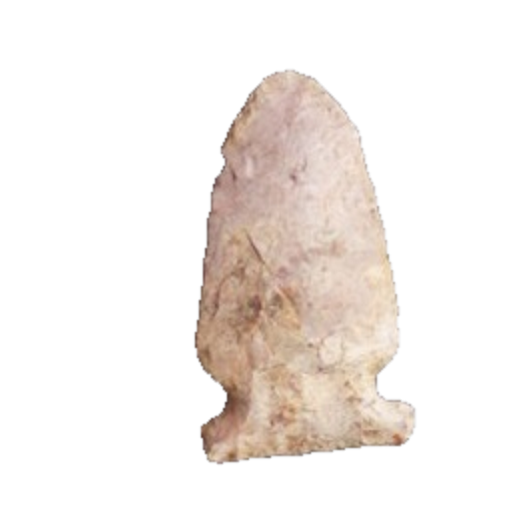
Arrowhead type
Big Sandy Broad Base Point
Big Sandy Broad BaseLarge Side Notch Cluster10,000 - 8,000,B.P.Early Archaic4 reference photos
Key facts
- Age
- 10,000 - 8,000,B.P.
- Cultural period
- Early Archaic
- Size
- Medium to Large
- Shape
- Side Notch
- Glacial period
- Early Holocene
More from the Archaic period
Description
This artifact exhibits a distinctive side notch configuration, typically falling within the small to medium size range. The cross-sectional profile of the blade is often compressed, although it can also assume an elliptical or rhomboid shape. The blade's longitudinal curvature is predominantly excurvate, but straight examples are also present. Additionally, some specimens display serrations along the blade edge. The notches are characterized by parallel alignment, with their orientation varying from horizontal to a pronounced upward inclination. The stem is broadly expanded, and the base of the point exhibits a range of shapes, from straight to concave, with a consistent trait being a base width that exceeds that of the blade. The flaking pattern observed on this point is random, lacking a discernible order or sequence.
Size
The arrowheads exhibit the following dimensional characteristics: their overall length ranges from 37 to 53 mm, with a mean length of 44 mm. The stem, which forms the base of the arrowhead, measures between 11 and 17 mm in length, averaging 15 mm. In terms of width, the blade spans 21 to 38 mm, with an average width of 25 mm. The neck, the narrower section just above the stem, varies in width from 17 to 23 mm, averaging 19 mm. The stem itself is relatively wide, measuring between 23 and 32 mm, with an average width of 29 mm, notably wider than the shoulder area. Lastly, the thickness of the arrowheads ranges from 5 to 10 mm.
Distribution
These artifacts are predominantly concentrated in the Tennessee River basin and exhibit a high incidence in the Ohio River basin. They appear less frequently in the remaining designated regions.
Mainly found in
Also found, less often, in
Additional information
More information needed.
Identified by
- Named by
- James Cambron
- Year
- 1975
Similar types
Types that are easy to confuse with the Big Sandy Broad Base point.
- Black Sand
- Bolen
- Cache River
- Ensor
- Fairland
- Frio
- Godar
- Graham Cave
- Hemphill
- Hickory Ridge
- Kessell
- MacCorkle
- Newton Falls
- Osceola
- Raddatz
- Rowan
- Savage Cave
- St. Charles
- Taylor Side Notch
Other types in the Large Side Notch Cluster
- Big Sandy
- Big Sandy Constricted Base
- Big Sandy Leighton Base
- Big Sandy E-Notch
- Greenbrier
- Howard County
- Madison Side Notched
- Osceola Greenbrier
- Simonsen