
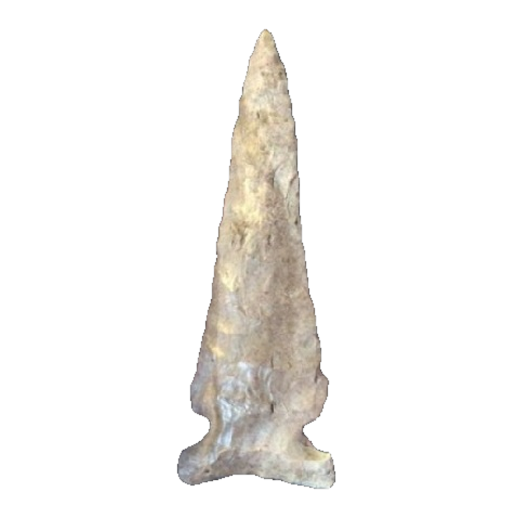
Arrowhead type
Hemphill Point
Hemphill4,500 - 3,000 B.P.Middle Archaic to Late Archaic19 reference photos
Key facts
- Age
- 4,500 - 3,000 B.P.
- Cultural period
- Middle Archaic to Late Archaic
- Culture
- Red Ocher Culture
- Size
- Medium to Large
- Shape
- Side Notch to Bifurcated
- Material
- Copper
- Glacial period
- Neoglacial
More from the Archaic period
Description
This triangular side-notched point exhibits a medium to large size profile, characterized by a flattened cross-sectional morphology. The blade's curvature is predominantly excurvate, with some specimens displaying parallel lateral edges. Fine serrations are a common feature, adding to the point's intricate morphology. The notches are typically broad and parallel, positioned proximally at the base of the blade, often within the lower eighth segment. The basal ears maintain continuity with the blade's curvature, while the base itself can vary from a straight to a concave configuration. The flaking pattern is random, yet many examples demonstrate a high level of craftsmanship, underscoring the point's technical sophistication.
Size
The dimensions of these arrowheads are characterized by a total length ranging from 50 to 230 mm, with a typical average length of 55 to 65 mm. The hafting or stem section measures between 12 to 20 mm in length, while the blade or stem width spans 25 to 40 mm. Additionally, the neck width is observed to be between 20 to 27 mm.
Distribution
These artifacts are mainly concentrated in the southern Illinois River basin and stretch into the central Mississippi River basin and the southern Missouri River basin. Their range expands into Wisconsin and sweeps westward into the Jefferson City area of Missouri. Occurrence dwindles southward into Arkansas
Additional information
In the realm of Native American arrowheads, the Hemphill points exhibit a notable distinction in terms of craftsmanship and size when compared to their counterparts, the Osceola points. While sharing similarities with the Osceola points, which emerged at a later period, the Hemphill points are characterized by a superior quality of workmanship and larger dimensions. This disparity in quality and size underscores the unique cultural context in which these arrowheads were created.
The Osceola points, for instance, have been linked to the Old Copper Culture, a significant archaeological complex that highlights the technological and artistic achievements of ancient Native American communities. In contrast, the Hemphill points are associated with the Red Ocher culture, as noted by Perino in 1971. This cultural affiliation provides valuable insights into the lives and traditions of the people who crafted these arrowheads, shedding light on the cultural exchange networks, technological innovations, and artistic expressions that defined these prehistoric societies.
The association of Hemphill points with the Red Ocher culture and Osceola points with the Old Copper Culture underscores the complexity and diversity of Native American cultural landscapes. By examining the variations in arrowhead design, size, and workmanship, archaeologists can reconstruct the social, economic, and technological dynamics that shaped the lives of ancient communities. The study of these artifacts not only enhances our understanding of Native American cultures but also highlights the importance of preserving and respecting the cultural heritage of these communities, acknowledging the significant contributions they made to the rich tapestry of human history.
Identified by
- Named by
- Edward G. Scully
- Year
- 1951
- Type site
- Hemphill site, Brown County, Illinois
Similar types
Types that are easy to confuse with the Hemphill point.
Other types in this cluster
- Big Sandy
- Cache River
- Godar
- Graham Cave
- Greenbrier
- Madison Side Notch
- Osceola Greenbrier
- Raddatz
- Simonsen