
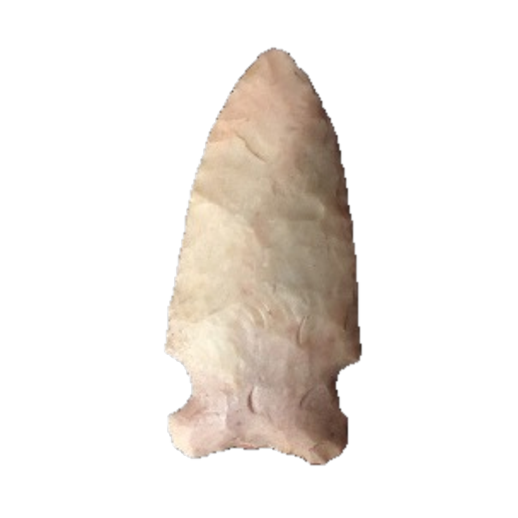
Arrowhead type
Simonsen Point
SimonsenLarge Side Notch Cluster8,000 - 6,000 B.P.Early Archaic to Middle Archaic2 reference photos
Key facts
- Age
- 8,000 - 6,000 B.P.
- Cultural period
- Early Archaic to Middle Archaic
- Size
- Medium to Large
- Shape
- Side Notch to Bifurcated
- Glacial period
- Middle Holocene
More from the Archaic period
Description
This medium-sized, triangular point features a distinctive elliptical cross-section and a broad blade that typically exhibits a straight profile, although some specimens may display a subtle excurvate curvature. The parallel, U-shaped notches are positioned relatively low on the blade, often with a width that matches their depth. The point's maximum width is typically achieved at the shoulders and base. An expanding stem and a base that ranges from straight to concave characterize this point, with basal corners that are usually squared and taper inward. The base is often thinned through a process of long, precise pressure flaking, which may be supplemented by shorter pressure flakes and basal grinding. The overall flaking pattern is the result of a combination of random percussion flaking during the initial manufacturing stage, followed by a finishing process that employs pressure flaking, yielding a complex, random pattern of flake scars.
Size
The dimensions of the arrowheads are characterized by a total length ranging from 20 to 50 mm and a blade width spanning from 19 to 32 mm.
Distribution
These artifacts predominantly occur in Nebraska and Iowa. They can also appear in additional regions, albeit with reduced regularity.
Mainly found in
Also found, less often, in
Additional information
In the realm of Native American arrowheads, several types exhibit striking similarities, often blurring the lines between distinct classifications. The Simonsen point, for instance, is frequently grouped with other types, forming a continuum of related forms. Notably, the Turin point is sometimes combined with this type in archaeological literature, despite a key distinction: the notch on a Turin point originates from the corners, whereas on a Simonsen point, it enters from the side. This subtle difference underscores the complexity of arrowhead typology.
Research by Morrow (1984) suggests that the Simonsen point is, in fact, equivalent to the Little Sioux point found in Iowa, while others propose that it is analogous to the Long Creek point from Saskatchewan. Interestingly, the Long Creek point is often considered synonymous with the Oxbow point, highlighting the nuanced relationships between these arrowhead types. A chronological analysis of the accepted dates for these types reveals a potential sequence: the Turin point, associated with the Early Archaic period, may have been followed by the Simonsen/Little Sioux point, which spans the Early to Middle Archaic period, and ultimately gave rise to the Long Creek/Oxbow point, characteristic of the Middle Archaic period. Furthermore, Morrow (2006) observes that Avonlea points share a similar outline with these types but are significantly smaller and thinner, likely representing true arrow points.
The Simonsen point also bears resemblance to the Rustad Quarry points found in North Dakota, although the latter are generally smaller. This size discrepancy may be attributed to the local material used in the manufacture of Rustad Quarry points (W11). The similarity between these two points raises the possibility that they represent the same type, with the size variation being a function of the available raw materials. As archaeological research continues to refine our understanding of Native American arrowheads, the study of these subtle variations and relationships offers valuable insights into the technological, cultural, and chronological contexts of these ancient artifacts.
Identified by
- Named by
- George Agogino and W.D. Frankforter
- Year
- 1960
- Type site
- Simonsen Site, along the Little Sioux River, northeastern Iowa
Similar types
Types that are easy to confuse with the Simonsen point.
- Avonlea
- Hickory Ridge
- Howard County
- Little Sioux
- Long Creek
- Oxbow
- Samantha
- Turin
- Tama
- Yonkee
Other types in the Large Side Notch Cluster
- Big Sandy
- Cache River
- Godar
- Graham Cave
- Greenbrier
- Hemphill
- Madison Side Notched
- Osceola
- Osceola Greenbrier
- Raddatz