
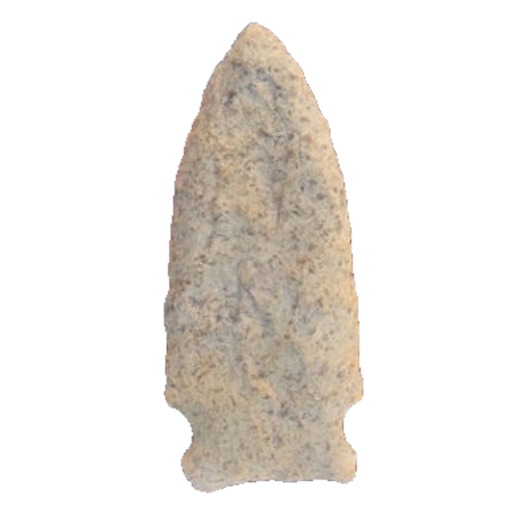
Arrowhead type
Greenbrier Point
GreenbrierLarge Side Notch Cluster9,500 - 8,000 B.P.Early Archaic16 reference photos
Key facts
- Age
- 9,500 - 8,000 B.P.
- Cultural period
- Early Archaic
- Size
- Medium to Large
- Shape
- Side Notch
- Glacial period
- Early Holocene
More from the Archaic period
Description
This triangular side-notched point exhibits a medium to large size profile, characterized by a cross-sectional shape that ranges from flattened to convex. The blade's curvature is predominantly excurvate, often featuring fine serrations along its edge. The notches are distinctive, being broad and shallow, which gives rise to shoulders that can exhibit a range of orientations, from horizontal to upwardly sloping, although these shoulders tend to be weakly defined. The stem expands outward, while the base of the point can display a straight or concave morphology. Notably, the area intended for hafting shows evidence of intense grinding. The flaking pattern observed on this point is random, lacking a consistent or deliberate pattern.
Size
The dimensions of the arrowheads are characterized by the following measurements: overall length ranges from 40 to 80 mm, with a mean length of 56 mm. The stem portion measures between 8 and 16 mm in length. In terms of width, the arrowheads span from 20 to 38 mm, averaging 23 mm. The width of the stem typically falls within the range of 20 to 30 mm. Thickness varies from 4 to 8 mm, with an average thickness of 7 mm.
Distribution
This projectile is distributed throughout the Tennessee River Basin, southern Mississippi Valley, and along the Gulf coastline. This projectile may occasionally be discovered in inland Florida.
Additional information
In the realm of Native American arrowhead classification, the work of Justice (1987) is notable for categorizing a particular point within the Dalton cluster. However, upon closer examination, this point exhibits characteristics that align more closely with the Large Side Notch cluster, due to its distinctive morphological features. One of the notable challenges in identifying this point is the variability of its base, which can manifest in several forms, including straight, lobed, concave, eared, or bifurcated. This diversity in basal morphology necessitates a careful consideration of other diagnostic attributes.
Key identification features of this point include a heavily ground haft region, which suggests a significant amount of effort was invested in preparing the point for attachment to a shaft. Additionally, the presence of fine secondary edge flaking, as observed in specimens designated W10, provides a crucial clue for distinguishing this type. These characteristics, combined with the point's overall morphology, enable researchers to accurately classify and understand its significance within the context of Native American lithic technology.
It is also worth noting that similar variations of this point type have been found in the Gulf Coastal region, where they are referred to as Florida Greenbrier. The presence of these points in this region highlights the complex and dynamic nature of prehistoric cultural exchange and technological diffusion. By examining the characteristics and distribution of these points, archaeologists can gain valuable insights into the lives and traditions of the indigenous peoples who created them, and shed light on the broader cultural and historical contexts in which they were used.
Identified by
- Named by
- Thomas M. N. Lewis and Madeline Kneberg
- Year
- 1958
- Type site
- Nuckolls Site, Humphrey County, Tennessee
Similar types
Types that are easy to confuse with the Greenbrier point.
Other types in the Large Side Notch Cluster
- Big Sandy
- Cache River
- Godar
- Graham Cave
- Hemphill
- Howard County
- Madison Side Notched
- Osceola
- Florida Greenbrier
- Raddatz
- Simonsen