
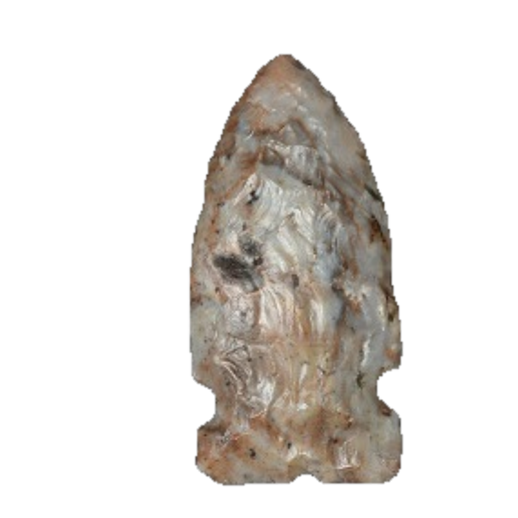
Arrowhead type
Godar Point
GodarLarge Side Notch Cluster4,500 - 3,500 B.P.Middle Archaic to Lakte Archaic25 reference photos
Key facts
- Age
- 4,500 - 3,500 B.P.
- Cultural period
- Middle Archaic to Lakte Archaic
- Culture
- Red Ocher Culture
- Size
- Medium to Large
- Shape
- Side Notch
- Glacial period
- Neoglacial
More from the Archaic period
Description
This triangular point exhibits a medium-sized profile, characterized by a side-notched configuration and a cross-sectional shape that ranges from flattened to elliptical. The blade itself is notably broad, displaying a curvature that can be either straight or excurvate, and often features fine serrations along its edge. In some instances, the tip of the point curves inward, causing the blade to align parallel to the shoulders. The notches are U-shaped and exhibit a consistent width-to-depth ratio. The shoulders are predominantly horizontal, merging with an expanded stem that is typically short in length and equivalent in width to the shoulders. The base of the point is generally straight, although it can be slightly convex, and its shape can vary from squarish to rounded, often accompanied by basal thinning. Flakes frequently extend along the length of the notches, and the basal area may display evidence of light to moderate grinding, indicative of hafting. The point's manufacture involves an initial stage of random percussion flaking, followed by pressure flaking for finishing and retouching, resulting in a random flaking pattern that demonstrates skilled craftsmanship.
Size
The arrowheads exhibit a range of dimensions, with total lengths spanning 54 to 140 mm. The stem, a crucial component, measures between 13 and 20 mm in length. In terms of width, the blade ranges from 22 to 40 mm, while the stem width falls within the same range of 22 to 40 mm. Notch depth is typically between 5 and 6 mm, although it can vary from 4 to 8 mm. The thickness of the arrowheads is consistently between 9 and 11 mm.
Distribution
These artifacts are mainly discovered in the southern Illinois River basin and stretching into the neighboring Mississippi and Missouri river basins. Their range expands into the middle to upper sections of the Mississippi River basin and into the Ohio River basin's
Also found, less often, in
Additional information
In a comparative analysis of Middle Archaic side-notched points, Morrow (2016) observes that the Godar and Raddatz points exhibit virtually identical morphological characteristics. This similarity has led some researchers to suggest that the distinction between these two types may be more a matter of regional terminology than a reflection of distinct typological differences. Specifically, medium-sized, side-notched points discovered in Illinois are typically classified as Godar points, while similar points found in Wisconsin are referred to as Raddatz points. Upon closer examination, it becomes apparent that the boundaries between these two types can become blurred, particularly when considering atypical specimens. As the characteristics of these points deviate from their typical forms, they begin to overlap, making it challenging to distinguish between the two types without considering the broader contextual framework in which they are found.
A notable variation of the Godar point is the Brannon point, which is distinguished by its less pronounced notches. According to Martens (2009), the notches on Brannon points are approximately 50% smaller than those found on classic Godar points. This subtle difference can lead to confusion, particularly in the greater St. Louis area, where archaeologists often group Brannon points with Godar points, eschewing the Raddatz designation altogether. This regional inconsistency in terminology highlights the complexities of typological classification and underscores the importance of considering multiple contextual factors when attempting to distinguish between closely related point types.
The overlap between Godar, Raddatz, and Brannon points serves as a reminder of the nuanced and often provisional nature of archaeological classification systems. As our understanding of these point types continues to evolve, it is essential to remain mindful of the regional and cultural contexts in which they were created and used. By acknowledging the complexities and ambiguities inherent in these classification systems, researchers can work towards a more nuanced and accurate understanding of the technological, social, and cultural dynamics that shaped the lives of Middle Archaic communities in the region.
Identified by
- Year
- 1968
- Type site
- Godar Site, Calhoun County, Illinois
Similar types
Types that are easy to confuse with the Godar point.
Other types in the Large Side Notch Cluster
- Brannon
- Big Sandy
- Cache River
- Graham Cave
- Greenbrier
- Howard County
- Madison Side Notched
- Osceola
- Osceola Greenbrier
- Raddatz
- Simonsen