
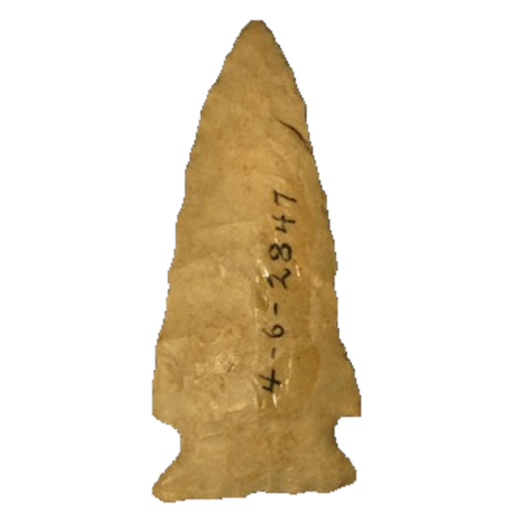
Arrowhead type
Ensor Point
Ensor2,200 - 1,400 B.P.Transitional Archaic31 reference photos
Key facts
- Age
- 2,200 - 1,400 B.P.
- Cultural period
- Transitional Archaic
- Size
- Medium to Large
- Shape
- Corner Notch to Expanding Stem
- Glacial period
- Roman Warm
More from the Archaic period
Description
This triangular corner notch point exhibits a slender profile with a medium to large size range, characterized by a flattened cross-sectional morphology. The blade edge is predominantly straight, although it may exhibit subtle deviations towards a gently excurvate shape, and in some instances, features fine serrations. Upon re-sharpening, the blade can transform into an incurvate or recurvate form. The shoulders typically display a barbed configuration, but may assume a more horizontal orientation, particularly in re-sharpened specimens. The notches are generally moderately shallow, resulting in a broad neck that merges with a stem of considerable width, often comparable to that of the shoulders. Notably, even when the base is narrower than the shoulders, the combination of shallow notches and a broad neck remains a distinctive characteristic of this type, as observed by Suhm and Krieger (1954). The basal edge can range from slightly concave to slightly convex, while the flaking pattern appears to be random, lacking a discernible order or orientation.
Size
The arrowhead's dimensions are characterized by a total length ranging from 30 to 70 mm, with a mean length of 50 mm. The stem measures between 6 and 11 mm in length. At the shoulders, the width spans 20 to 30 mm, while the neck width varies from 13 to 18 mm. Additionally, the stem width is recorded between 20 and 28 mm.
Distribution
This type is mainly located in areas spanning central Texas to the lower Pecos River valley and across the Guadalupe River valley. It appears less often in the Sabine River Valley of eastern Texas and western Louisiana, as well as Arkansas and Oklahoma. Occurrences decrease in southern Tamaulipas
Additional information
In the realm of Native American arrowheads, the classification of certain point types has undergone significant refinement over the years. Dan R. Davis (1991) proposed a categorization system that divides these points into three distinct sub-categories: Type I, characterized by a concave base; Type II, featuring a slight convex base; and Type III, marked by a straight base. Notably, Davis's classification does not account for the split stem variety.
The Ensor and Frio type points have a complex history of classification. Initially, both types were grouped together as Ensor points at the Belton Reservoir site by Miller and Jelks. However, Suhm et al. (1954) later redefined the Ensor type, excluding Frio points from this classification. As a result, many collectors refer to Frio type points associated with Ensor points as either Ensor Split Stem or Ensor Frio points. A key distinguishing feature between Ensor Frio and Frio type points lies in the notch and shoulder morphology. Ensor Frio points exhibit a narrow diagonal notch accompanied by a slightly barbed shoulder, whereas Frio type points display a wider parallel notch with a shoulder that is typically angled upward. Furthermore, the basal edge of these two types differs, with Ensor Frio bases often featuring a notched or V-shaped appearance, while Frio bases tend to have a recurvate edge.
The Juno Broad Base type, identified by J.C. Kelley (1947), is notable for its base extending beyond the shoulders, paired with a shallow notch and broad neck. Suhm and Kreiger (1954) observed that this type falls within the normal variation of the Ensor type and chose to include it in their work as an Ensor point. Interestingly, these authors also drew comparisons between Ensor points and Marcos points, highlighting the distinctive characteristics of the latter, including longer, deeper notches that form a narrower neck, as well as a base that is consistently narrower than the shoulders. These subtle differences underscore the complexity and diversity of Native American arrowhead types, emphasizing the need for nuanced classification and analysis in the field of archaeology.
Identified by
- Named by
- E. O. Miller and Edward B. Jelks
- Year
- 1952
- Type site
- Belton Reservoir, Coryell County, Texas
Similar types
Types that are easy to confuse with the Ensor point.