
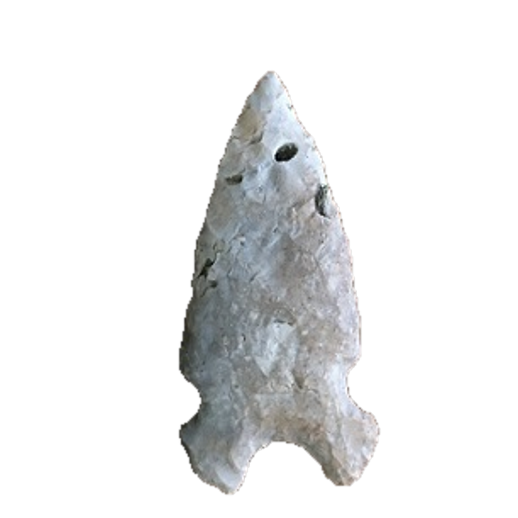
Arrowhead type
Big Sandy Contracting Base Point
Big Sandy Contracting BaseLarge Side Notch Cluster10,000 - 8,000,B.P.Early Archaic10 reference photos
Key facts
- Age
- 10,000 - 8,000,B.P.
- Cultural period
- Early Archaic
- Size
- Medium to Large
- Shape
- Side Notch to Bifurcated
- Glacial period
- Early Holocene
More from the Archaic period
Description
This specimen exhibits a distinctive morphology, characterized by a medium to large size and a bifurcated configuration. In cross-section, the point displays an elliptical shape. The blade itself is marked by an excurvate profile, featuring parallel notches that transition from a horizontal orientation to a more upwardly angled position. The stem expands outward, potentially presenting an auriculate appearance. The basal region is notable for its deeply concave to bifurcated shape, accompanied by evidence of basal grinding. The predominant flaking pattern observed is random, although a smaller subset of examples exhibits parallel transverse flaking.
Size
The arrowhead's dimensions are characterized by the following measurements: its overall length ranges from 35 to 45 mm, with a mean length of 39 mm. The stem, which connects the blade to the base, measures between 10 and 13 mm in length, averaging 11 mm. The blade itself spans a width of 16 to 26 mm, with an average width of 22 mm. At the neck, the width varies from 10 to 17 mm, averaging 14 mm. The stem's width falls within the range of 18 to 23 mm, with an average of 21 mm. In terms of thickness, the arrowhead measures between 6 and 9 mm. Additionally, the basal concavity, which refers to the curvature at the base, is observed to be between 1 and 3 mm.
Distribution
These artifacts are predominantly concentrated in the Tennessee River basin and exhibit a high prevalence in the Ohio River basin. They appear less frequently in the remaining designated regions.
Mainly found in
Also found, less often, in
Additional information
In the realm of Native American arrowhead typology, a notable distinction can be made between two primary forms: the auricle and the constricted. A key characteristic of the auricle form is the presence of rounded "ears" or protrusions, which are a defining feature of this type. In contrast, the constricted form exhibits a base with wider, flatter "ears" that are often more bifurcated, resulting in a distinct morphological profile. This differentiation is crucial for archaeologists seeking to classify and understand the various types of arrowheads crafted by Native American cultures. By examining the shape and structure of these projectile points, researchers can gain valuable insights into the technological, cultural, and historical contexts in which they were created.
Identified by
- Named by
- James Cambron
- Year
- 1975
Similar types
Types that are easy to confuse with the Big Sandy Contracting Base point.
- Black Sand
- Bolen
- Cache River
- Ensor
- Fairland
- Frio
- Godar
- Graham Cave
- Hemphill
- Hickory Ridge
- Kessell
- MacCorkle
- Newton Falls
- Osceola
- Raddatz
- Rowan
- Savage Cave
- St. Charles
- Taylor Side Notch
Other types in the Large Side Notch Cluster
- Big Sandy
- Big Sandy Broad Base
- Big Sandy Leighton Base
- Big Sandy E-Notch
- Greenbrier
- Howard County
- Madison Side Notched
- Osceola Greenbrier
- Simonsen