
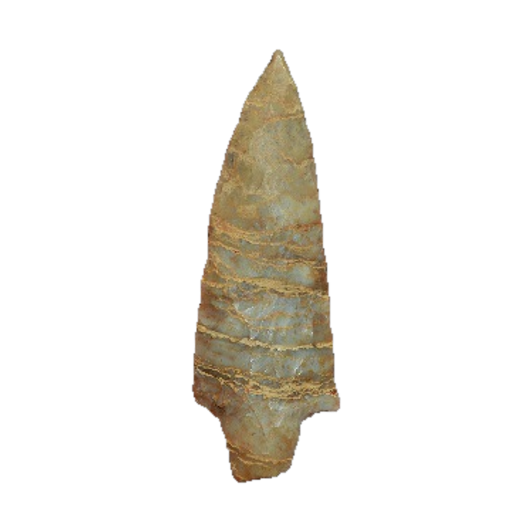
Arrowhead type
Mabin Point
MabinDickson Contracting Stem Cluster3,500 - 1,900 B.P.Late Archaic to Early Woodland9 reference photos
Key facts
- Age
- 3,500 - 1,900 B.P.
- Cultural period
- Late Archaic to Early Woodland
- Size
- Medium to Large
- Shape
- Contracting Stem to Straight Stem
- Glacial period
- Neoglacial to Medieval Warm
Description
This triangular point exhibits a medium to large size profile, characterized by a contracting stem and an elliptical cross-sectional shape. The blade edge displays variability, ranging from a straight alignment to a gently outward-curving, excurvate shape. The shoulder morphology is also diverse, spanning from subtly barbed to nearly horizontal configurations. The stem tapers inward, terminating in a straight base. The flaking pattern observed on this point is random, lacking a discernible, organized arrangement.
Size
The dimensions of the arrowheads are as follows: they range in length from 27 to 67 mm, with a mean length of 55 mm. In terms of width, they measure between 15 and 23 mm, averaging 18 mm. The thickness of the arrowheads varies from 4 to 11 mm, with an average thickness of 8 mm.
Distribution
These artifacts are scattered throughout the central to southern Mississippi River Valley, with the greatest densities located in Texas, Oklahoma, Louisiana, and Arkansas
Additional information
In the realm of Native American arrowheads, a distinct type has been identified, characterized by a slender blade that tapers into a contracting stem, ultimately giving way to a straight base. This particular variation is categorized within the Gary classification system as Class A. Notably, this style of arrowhead is marked by its narrow, elongated blade, which suggests a high degree of precision and craftsmanship in its creation. The contracting stem, a hallmark of this type, serves to distinguish it from other arrowhead forms, while the straight base provides a stable platform for hafting. As a result, this arrowhead type offers valuable insights into the technological and cultural practices of the Native American groups that created it, highlighting their resourcefulness and adaptability in tool manufacture.
Identified by
- Named by
- Alan Toth
- Year
- 1979
Similar types
Types that are easy to confuse with the Mabin point.