
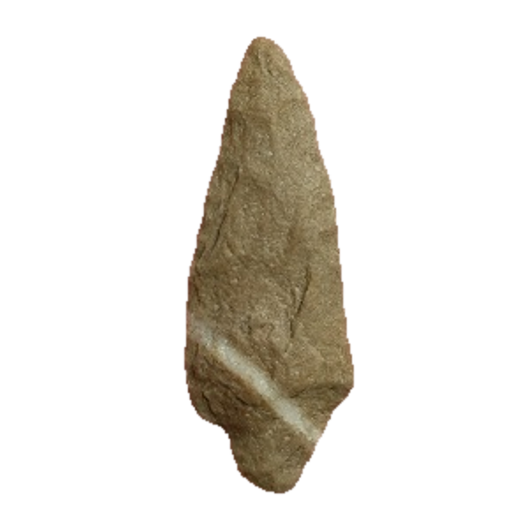
Arrowhead type
Rossville Point
RossvilleDickson Contracting Stem Cluster2,600 - 1,700 B.P.Early Woodland9 reference photos
Key facts
- Age
- 2,600 - 1,700 B.P.
- Cultural period
- Early Woodland
- Size
- Medium
- Shape
- Contracting Stem to Ovoid
- Material
- Jasper
- Glacial period
- Neoglacial to Roman Warm
More from the Woodland period
Description
This medium-sized point exhibits a distinctive stem configuration, characterized by a contracting shape and an elliptical profile. The blade edge displays a range of curvature, fluctuating between excurvate and straight forms. The shoulder regions are marked by rounded contours, typically inclined at an upward angle. The stem tapers towards its base, which can be either pointed or rounded in shape. The flaking pattern observed on this point is random, lacking a discernible order or organization.
Size
The arrowheads exhibit a range of dimensions, with overall lengths spanning 32 to 64 mm, and a mean length of 40 to 50 mm. The stem portion measures between 9 and 18 mm in length. In terms of width, the arrowheads vary from 14 to 33 mm, with an average width of 21 mm. Thickness ranges from 6 to 10 mm.
Distribution
This type is mainly discovered in southeastern New England and down to Virginia. Typically located along the Eastern Seaboard areas.
Also found, less often, in
Additional information
In the realm of Native American arrowheads, distinct characteristics set apart the Rossville and Piscataway points. Notably, Rossville points exhibit a broader width and more accentuated shoulders and stem compared to their Piscataway counterparts. This differentiation is also reflected in the materials used for their construction. While Piscataway points are predominantly crafted from quartz, Rossville points demonstrate a more varied use of local materials, highlighting the adaptability and resourcefulness of their creators. This diversity in material selection is a significant aspect of Rossville points, as documented in archaeological records (W10), and underscores the unique cultural and technological contexts in which these points were produced.
Identified by
- Named by
- Alanson Skinner
- Year
- 1909
- Type site
- Rossville Site, Staten Island, New York
Similar types
Types that are easy to confuse with the Rossville point.
Other types in the Dickson Contracting Stem Cluster
- Adena
- Adena Dickson
- Gary
- Little Bear Creek
- Poplar Island