
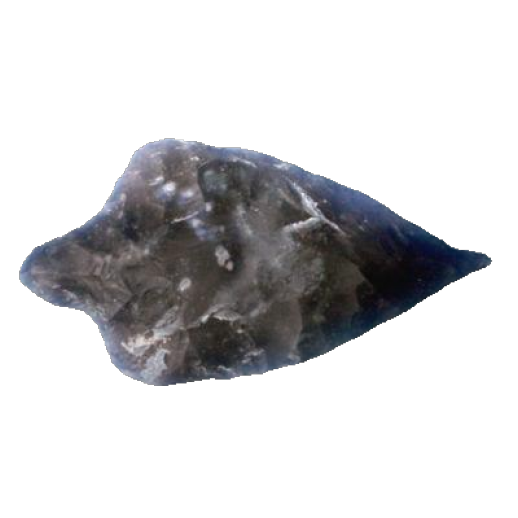
Arrowhead type
Almagre Point
Almagre5,000 - 4,000 B.P.Middle Archaic5 reference photos
Key facts
- Age
- 5,000 - 4,000 B.P.
- Cultural period
- Middle Archaic
- Size
- Medium to Large
- Shape
- Contracting Stem
- Material
- Pottery
- Glacial period
- Middle Holocene
More from the Archaic period
Description
This medium to large-sized triangular point exhibits a distinctive elliptical cross-section and a broad, thick blade. The edges of the blade are predominantly excurvate, although they can vary from inwardly recurvate to straight, often resulting in an asymmetrical shape where one edge is straighter than the other. The shoulders of the point can display a range of morphologies, from an upward angle to a barbed configuration. The stem is typically contracting, but can also be only slightly so, and is accompanied by a base that can be straight, slightly convex, or concave, with rounded corners at the basal extremities. The manufacturing process often involves the removal of a few percussion flakes, which can leave noticeable scars on the point's faces, oriented towards the center. Final shaping is achieved through a combination of controlled percussion flaking and pressure flaking, yielding a random flaking pattern that characterizes the point's surface.
Size
The dimensions of these arrowheads are characterized by a length range of 47 to 100 mm, with a typical average length falling between 59 to 80 mm. The stem length varies from 3 to 20 mm, averaging between 8 to 12 mm. In terms of width, the arrowheads measure between 30 to 50 mm, with an average width of 36 mm. The stem width ranges from 13 to 30 mm, averaging 20 mm. The thickness of these artifacts spans 5 to 15 mm, with an average thickness of 6 mm, as reported by Suhm and Krieger (1954) and MacNeish (1967).
Distribution
This arrowhead type is mainly located in the southernmost part of Pecos and extends into the southern areas of Texas and the northeastern parts of Mexico. It has also been discovered throughout the southern regions of Tamaulipas, Chiapas, Puebla, Hidalgo, Queretaro, the Mexico Valley, Tehuacan Valley, Cueva de la Nopalera, Hidalgo, and the western areas of Mexico
Also found, less often, in
Additional information
In the realm of Native American arrowhead studies, certain artifacts have been proposed as potential preforms for specific point types, including the Gary and Langtry points, as suggested by Turner and Hester in 1985. However, earlier research by Suhm and Krieger, dating back to 1954, highlights that each of these point types exhibits unique distribution patterns, implying distinct cultural or geographical associations. Notably, the point in question bears a resemblance to the Gary point, yet its overall craftsmanship is generally coarser, distinguishing it from the more refined characteristics typically observed in Gary points. This distinction underscores the importance of careful analysis in identifying and categorizing arrowhead types, as subtle variations can reveal significant insights into the technological and cultural practices of Native American groups.
Identified by
- Named by
- Dee Ann Suhm
- Year
- 1954
Similar types
Types that are easy to confuse with the Almagre point.
- Acatita
- Arledge
- Austin
- Gary
- Langtry
- Langtry Arenosa
- San Martin