
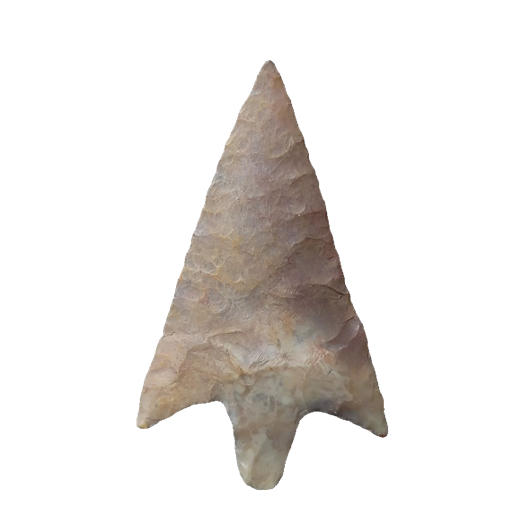
Arrowhead type
Langtry Point
Langtry4,500 - 3,000 B.P.Middle Archaic23 reference photos
Key facts
- Age
- 4,500 - 3,000 B.P.
- Cultural period
- Middle Archaic
- Size
- Medium to Large
- Shape
- Contracting Stem
- Glacial period
- Neoglacial
More from the Archaic period
Description
This triangular point exhibits a slender profile with a medium thickness, characterized by a stem that tapers inward. Its cross-sectional shape is typically elliptical, occasionally flattening into a more oval form. The blade's edge is predominantly straight, although subtle variations in curvature can occur, ranging from a slight inward curve (incurvate) to a gentle outward curve (recurvate), with rare instances of a more pronounced outward bend (excurvate). The shoulders of the point are notable for their prominence and often slope downward, but can also be found at a horizontal orientation or exhibit asymmetry. The stem's contracting shape is frequently accompanied by alternating bevels on both the stem and base, creating a distinctive pattern. The base of the point can display a range of shapes, from straight to slightly concave, with the notable exception of convex bases, which are more commonly associated with Langtry Arenosa points. Overall, this point is typically well-crafted, featuring a random flaking pattern that suggests a high degree of manufacturing skill.
Size
The arrowheads exhibit a range of dimensions, with lengths spanning 40 to 70 mm, and an average length of 60 mm. The stem, which accounts for approximately one-quarter to one-half of the overall length, measures between 10 to 15 mm. At the shoulders, the width varies from 22 to 40 mm, while the stem width ranges from 6 to 16 mm.
Distribution
This type is mainly discovered along the southern Pecos River, stretching into the Trans-Pecos area, and onward into southeast New Mexico and the northern parts of Coahuila and Tamaulipas. It reaches into the Nueces River Valley in Texas and central Tamaulipas. Occurrence rates decline as it approaches the coastal areas. Please refer to further notes regarding its expansion into
Mainly found in
Additional information
The Langtry arrowhead type has been a subject of interest among archaeologists, with notable studies conducted by Suhm and Krieger in 1954. Their research encompassed both the classic Langtry and the more recently identified Langtry Arenosa, which they considered as part of the Langtry type. Although they acknowledged the possibility that these two variants might represent distinct types, they emphasized the difficulty in drawing a clear distinction between them due to their continuum-like characteristics.
Earlier studies, such as those by Bell and Hall in 1947, reported the presence of Langtry-type arrowheads in Oklahoma and Missouri. However, subsequent examinations of these findings have revealed that the arrowheads discovered in these regions exhibit different characteristics compared to those found in southern Texas, where the Langtry type is predominantly associated. A closer inspection of the points from Oklahoma and Missouri by Suhm and Krieger led them to conclude that these specimens were misidentified as Langtry points. They observed that these points were narrower, thicker, and lacked the specific manufacturing techniques that are hallmarks of the Langtry type. This assessment has been supported by more recent research, including a study by Turner and Hester in 2014, which reaffirms that authentic Langtry points are primarily confined to southern Texas and do not extend into Oklahoma and Missouri.
The distinction between genuine Langtry points and those found in other regions is significant, as it highlights the importance of precise identification and classification in archaeology. The characteristics that define the Langtry type, such as its specific shape, size, and manufacturing techniques, are crucial in understanding the cultural and geographical context in which these arrowheads were created. By recognizing the unique features of the Langtry type and its limited geographical distribution, researchers can gain valuable insights into the lives and traditions of the Native American communities that crafted these artifacts, ultimately contributing to a more nuanced understanding of the region's rich cultural heritage.
Identified by
- Named by
- J. Charles Kelly
- Year
- 1940
- Type site
- Big Bend Region, Texas
Similar types
Types that are easy to confuse with the Langtry point.
Other types in this cluster
- Jora
- Langtry Arenosa