
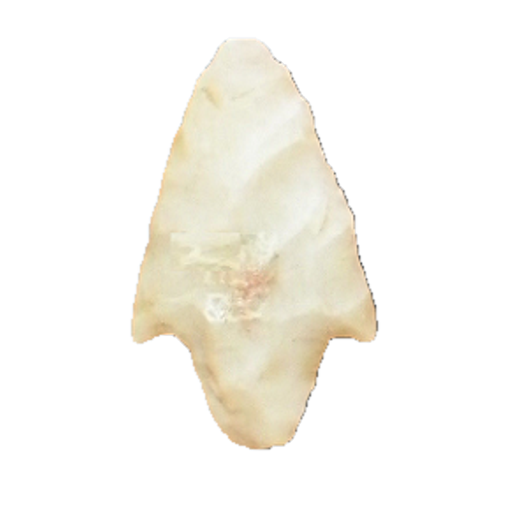
Arrowhead type
Dunn Point
DunnDickson Contracting Stem Cluster2,500 - 1,400 B.P.Transitional Archaic7 reference photos
Key facts
- Age
- 2,500 - 1,400 B.P.
- Cultural period
- Transitional Archaic
- Size
- Medium to Large
- Shape
- Contracting Stem
- Glacial period
- Neoglacial
More from the Archaic period
Description
This triangular point exhibits a distinctive morphology, characterized by a medium to large size and a tapering stem. Its cross-sectional profile is elliptical, providing a stable platform for the blade. The blade itself displays a predominantly excurvate shape, with shoulders that exhibit a range of orientations, from barbed to horizontal. The stem, which contracts towards the base, features a convex termination. The flaking pattern observed on this point is random, lacking a discernible order or sequence.
Size
The dimensions of these arrowheads range from 35 to 85 mm in length, although occasional specimens may fall outside of this size range. The stem width exhibits a fairly consistent pattern, wherein smaller examples typically have a stem that comprises approximately half of the total length, while larger examples have a stem that accounts for between one-quarter to one-third of the total length. Additionally, the width at the shoulders measures between 20 to 50 mm.
Distribution
This has been documented as occurring in southwestern Arkansas and extending into northeastern Oklahoma.
Also found, less often, in
Additional information
In the realm of Native American arrowheads, a distinct type has been identified, commonly known as the Shouldered Gary point. This particular point bears a striking resemblance to the Camden variation of the Gary point, leading some to suggest that they may be one and the same. The similarity between these two types is noteworthy, as it highlights the complexities and nuances of arrowhead classification. Further study is needed to fully understand the relationship between the Shouldered Gary point and its Camden counterpart, but it is clear that both types share a common ancestry and cultural significance.
The Shouldered Gary point is characterized by its distinctive shouldered shape, which sets it apart from other arrowhead types. This unique morphology is a testament to the ingenuity and craftsmanship of the Native American cultures that created these points. The fact that the Shouldered Gary point is often associated with the Camden variation of the Gary point suggests that there may have been cultural exchange or migration between the groups that produced these arrowheads. This highlights the importance of considering the broader cultural context in which these artifacts were created and used.
The study of the Shouldered Gary point and its relationship to the Camden variation of the Gary point offers valuable insights into the lives and traditions of Native American communities. By examining the characteristics and distribution of these arrowhead types, archaeologists can gain a deeper understanding of the technological, social, and cultural developments that shaped the lives of these communities. As research continues to uncover new information about these enigmatic artifacts, our appreciation for the complexity and richness of Native American cultures will only continue to grow.
Identified by
- Named by
- Leon Dunn
- Year
- 1992
Similar types
Types that are easy to confuse with the Dunn point.