
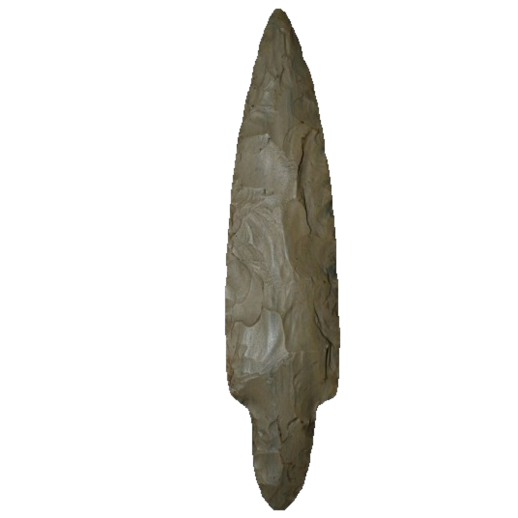
Arrowhead type
Waubesa Point
Waubesa2,500 - 1,800 B.P.Woodland16 reference photos
Key facts
- Age
- 2,500 - 1,800 B.P.
- Cultural period
- Woodland
- Culture
- Black Sand and Havana Hopewell cultures
- Size
- Medium to Large
- Shape
- Contracting Stem to Straight Stem
- Glacial period
- Neoglacial to Roman Warm
More from the Woodland period
Description
This stone point exhibits a robust, triangular to lanceolate morphology, measuring between 2 to 5 inches in length, with a distinctive elliptical cross-sectional profile. The blade itself is elongated, featuring a pronounced excurvate shape, where the maximum width is typically situated at the shoulder region. The shoulders are predominantly horizontal, although some specimens may display a subtle, upward-angled barb. The stem is characterized by its lengthy, contracting form, terminating in a base that can range from a convex, "beaver tail" configuration to a more pointed shape. Notably, basal grinding is absent in this point type. The manufacturing process involved random percussion flaking, supplemented by pressure flaking to refine and retouch the blade, resulting in a random, yet deliberate, flaking pattern.
Size
The arrowheads exhibit a range of dimensions, with lengths spanning 60 to 152 mm, and an average length of 101 mm. The stem length varies between 15 and 30 mm. In terms of width, the blade measures between 30 and 40 mm, while the stem width at the shoulders ranges from 12 to 20 mm.
Distribution
These artifacts are predominantly discovered in the Ohio River basin and the northern Mississippi River region
Additional information
The Waubesa point is a distinct variant of the Dickson point, characterized by its smaller size and more pointed base. Notably, this type has often been misattributed to the Adena culture due to shared characteristics, but archaeological evidence confirms its association with the Hopewell culture. Dating of these points suggests a timeframe of 2,500 to 1,800 years before present, although a more restricted age range of 2,100 to 1,900 years before present is also possible.
The Waubesa point has been found in conjunction with Black Sands ceramics, which may indicate a connection to the Black Sands phase, potentially representing an older, related form of the Belknap point. However, according to Howell (2001), Waubesa points are diagnostic of the Black Sands culture in western Wisconsin, highlighting their significance in understanding the cultural context of this region. In terms of its relationship to the Dickson point, the Waubesa point is considered an alternate variation, with some researchers, such as Winters, proposing that it represents a knife form of the Dickson point. Boszhardt (2005) offers an alternative interpretation, suggesting that Waubesa points were rapidly manufactured, expendable projectiles designed for easy removal and replacement from the main shaft.
A comparative analysis of Waubesa and Adena points reveals notable differences, despite their overlapping similarities. Adena points are distinguished by less defined shoulders and a blade width that is maximized above the shoulder area. In contrast, Waubesa points exhibit well-defined shoulders, with the widest part of the blade coinciding with the shoulder, as observed by Morrow (2016). This distinction is crucial in accurately identifying and differentiating between these point types, ultimately contributing to a more nuanced understanding of the cultural and technological developments of Native American communities during this period.
Identified by
- Named by
- David Baerris and Robert Ritzenthaler
- Year
- 1953
- Type site
- Blackhawk Village Site (Da5), Waubesa Lake, Dane County Wisconsin
Similar types
Types that are easy to confuse with the Waubesa point.
Other types in this cluster
- Dickson
- Belknap