
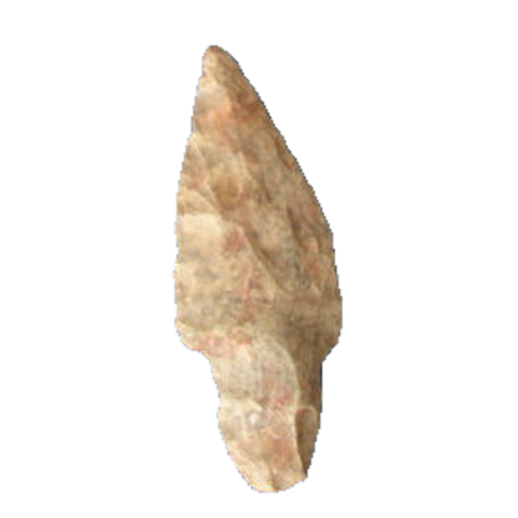
Arrowhead type
Melvern Point
MelvernDickson Contracting Stem Cluster3,500 - 1,900 B.P.Late Archaic to Early Woodland7 reference photos
Key facts
- Age
- 3,500 - 1,900 B.P.
- Cultural period
- Late Archaic to Early Woodland
- Size
- Medium to Large
- Shape
- Contracting Stem to Straight Stem
- Glacial period
- Neoglacial to Medieval Warm
Description
This triangular point exhibits a sturdy profile, characterized by a medium to large size and a distinctive elliptical cross-sectional shape. The blade edge can vary in curvature, ranging from a straight alignment to a more pronounced excurvate shape. Notably, the shoulders of the point are marked by an upward-tapering configuration. The stem, which contracts in width, may terminate in a pointed base or, alternatively, exhibit a slightly expanding form with a convex base. The manufacture of this point often appears rough-hewn, with a flaking pattern that lacks discernible organization, instead featuring a random arrangement of flakes.
Size
The dimensions of the arrowheads are as follows: in terms of length, they range from 27 to 67 mm, with a mean length of 55 mm. The width varies between 15 and 23 mm, averaging 18 mm. Thickness measurements fall within a range of 4 to 11 mm, with an average thickness of 8 mm.
Distribution
These artifacts are scattered throughout the central to southern Mississippi River Valley, with the greatest densities located in Texas, Oklahoma, Louisiana, and Arkansas
Mainly found in
Additional information
In the realm of Native American arrowhead typology, a distinct variation is characterized by its crude manufacture, often exhibiting narrow and poorly defined shoulders. Additionally, this type of point typically features a rounded base, which distinguishes it from other forms. Notably, this particular point style is classified as a Gary Type B point, a designation that reflects its unique combination of morphological traits. The crude craftsmanship and rounded base of this point type suggest a potentially earlier or more expedient production method, which may provide insight into the technological and cultural context of its creation.
The Gary Type B point classification is significant, as it allows archaeologists to situate this arrowhead variation within a broader cultural and chronological framework. By examining the characteristics of this point type, researchers can gain a deeper understanding of the technological, social, and economic factors that influenced the development of Native American lithic technology. The presence of Gary Type B points at archaeological sites can also inform our understanding of cultural exchange networks, migration patterns, and the evolution of hunting strategies among Native American groups.
Further study of this arrowhead variation can reveal additional nuances and characteristics that shed light on the lives and traditions of Native American communities. For instance, the crude manufacture and rounded base of Gary Type B points may indicate a focus on functional efficiency over aesthetic refinement, highlighting the practical considerations that drove the design and production of these artifacts. By continuing to explore and analyze these points, archaeologists can refine our understanding of Native American cultural and technological developments, ultimately enriching our appreciation for the complexity and diversity of indigenous cultures in North America.
Identified by
- Named by
- Frank Shambach
- Year
- 1998
Similar types
Types that are easy to confuse with the Melvern point.
- Adena Wells
- Almagre
- Coahuila
- Hidden Valley
- Morrow Mountain
- Wells