
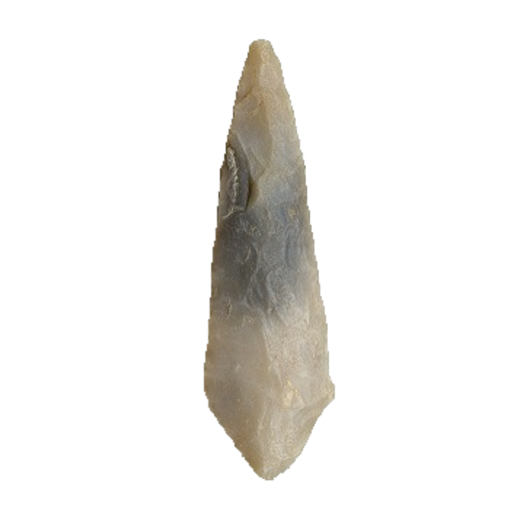
Arrowhead type
LeFlore Point
LeFloreDickson Contracting Stem Cluster3,500 - 1,900 B.P.Late Archaic to Early Woodland6 reference photos
Key facts
- Age
- 3,500 - 1,900 B.P.
- Cultural period
- Late Archaic to Early Woodland
- Size
- Medium to Large
- Shape
- Contracting Stem to Ovoid
- Glacial period
- Neoglacial to Medieval Warm
Description
This triangular point exhibits a stout profile, with a medium to large size and a tapering stem that contracts towards its base. Its cross-sectional shape is elliptical, while the blade itself displays an excurvate curvature. The shoulders are subdued, nearly imperceptible, and oriented at an upward slant. The stem is characterized by its broad, contracting shape and a base that is distinctly convex. The overall craftsmanship of this point is somewhat rough-hewn, with a flaking pattern that appears random and lacking in uniformity, suggesting a more expedient manufacturing technique.
Size
The dimensions of the arrowheads are as follows: they range in length from 27 to 67 mm, with a mean length of 55 mm. In terms of width, they measure between 15 and 23 mm, averaging 18 mm. The thickness of the arrowheads varies from 4 to 11 mm, with an average thickness of 8 mm.
Distribution
These artifacts are scattered throughout the central to southern Mississippi River Valley, with the greatest densities occurring in Texas, Oklahoma, Louisiana, and Arkansas
Mainly found in
Additional information
In the realm of Native American arrowheads, a specific category of points, known as Gary Class C, exhibits a distinctive characteristic. Notably, these points are defined by a pronounced angular relationship between the stem and the shoulders, with a measured angle exceeding 171 degrees. This striking feature serves as a diagnostic criterion for identifying Gary Class C points, facilitating a more nuanced understanding of the technological and cultural developments of the associated Native American groups.
The angular measurement of greater than 171 degrees between the stem and shoulders is a critical aspect of Gary Class C points, as it distinguishes them from other point types. This characteristic, likely resulting from the intentional design choices of the point's creators, highlights the ingenuity and craftsmanship of Native American artisans. By examining the specific attributes of Gary Class C points, researchers can gain valuable insights into the lives and traditions of the people who crafted and utilized these artifacts.
The identification and analysis of Gary Class C points contribute significantly to the field of archaeology, enabling a more comprehensive comprehension of the cultural, temporal, and spatial contexts in which these points were created and used. As archaeological research continues to uncover and interpret the remnants of Native American cultures, the study of Gary Class C points and their distinctive characteristics remains an essential component of this ongoing endeavor, offering a window into the technological, social, and cultural practices of the past.
Identified by
- Named by
- Frank Shambach
- Year
- 1998
Similar types
Types that are easy to confuse with the LeFlore point.