
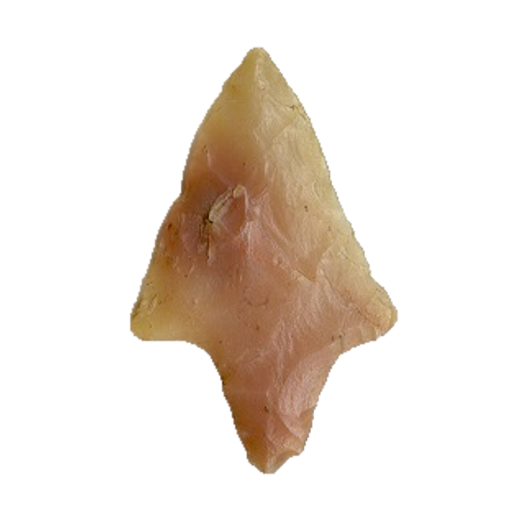
Arrowhead type
Gary Point
Gary3,500 - 1,900 B.P.Late Archaic to Early Woodland28 reference photos
Key facts
- Age
- 3,500 - 1,900 B.P.
- Cultural period
- Late Archaic to Early Woodland
- Size
- Medium to Large
- Shape
- Contracting Stem
- Glacial period
- Neoglacial to Roman Warm
Description
This triangular point exhibits a stout profile, measuring between 1.5 and 3.25 inches in length, with a cross-sectional shape that is elliptical in outline. The blade edge can vary in curvature, ranging from straight to excurvate, although some specimens display an incurvate shape. The shoulder morphology is diverse, encompassing forms that are slightly barbed, horizontal, or tapering upward. The stem, which contracts in width, may terminate in a pointed base or, in some cases, expand slightly to form a convex base. The flaking pattern observed on this point is characterized by a random arrangement of flakes.
Size
The dimensions of these arrowheads are characterized by a total length ranging from 35 to 85 mm, although occasional specimens may fall outside this scope. The stem, which comprises approximately 1/4 to 1/2 of the overall length, has a corresponding width. Measured at the shoulders, the width spans 20 to 50 mm. In terms of thickness, these arrowheads typically measure between 9 to 10 mm.
Distribution
These artifacts are scattered throughout the central to southern Mississippi River Valley, with the densest accumulations occurring in Texas, Oklahoma, Louisiana, and Arkansas
Mainly found in
Also found, less often, in
Additional information
The archaeological record reveals that the cluster of points in question spans a significant timeframe, from the late Archaic period to the early to middle Woodland period, approximately coinciding with the temporal boundaries established by Justice in 1987. Notably, the majority of points within this cluster are associated with the Adena culture, which was predominantly centered in the Ohio River valley. However, the specific point under consideration does not belong to the Adena culture, despite sharing morphological characteristics and a concurrent geographical and temporal context with other points in the cluster.
Further examination of these points has led to their categorization into five distinct groups, namely Camden, LeFlore, Mabin, Maybon, and Melvern, as outlined by Justice in 1987. The complexity and variability within this point type have been acknowledged by Cambron in 1986, who emphasized the need for subdivision due to the notable differences among the points. This subdivision is essential for a more nuanced understanding of the cultural and historical contexts in which these points were crafted and utilized.
The points in this cluster exhibit a range of characteristics that warrant further investigation, highlighting the importance of continued research and analysis in this area. By examining the morphological features, temporal contexts, and geographical distributions of these points, archaeologists can gain valuable insights into the cultural practices, technological developments, and historical events that shaped the lives of the people who created and used them. Ultimately, a more detailed understanding of these points can contribute significantly to our knowledge of the late Archaic to early Woodland periods, and the cultures that flourished during this time, including the Adena culture and other contemporaneous societies.
Identified by
- Named by
- Perry H. Newell and Alex D. Krieger
- Year
- 1949
- Type site
- George C. Davis Site, Cherokee County, Texas
Similar types
Types that are easy to confuse with the Gary point.
Other types in this cluster
- Adena Dickson
- Dunn
- Little Bear Creek
- Poplar Island
- Rossville