
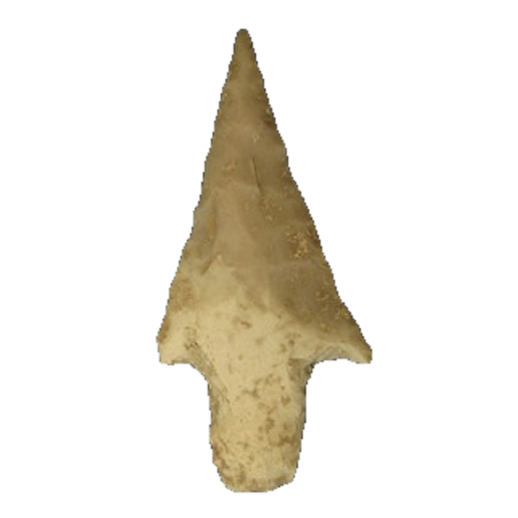
Arrowhead type
Langtry Arenosa Point
Langtry Arenosa4,500 - 3,000 B.P.Middle Archaic9 reference photos
Key facts
- Age
- 4,500 - 3,000 B.P.
- Cultural period
- Middle Archaic
- Size
- Medium to Large
- Shape
- Contracting Stem
- Glacial period
- Neoglacial
More from the Archaic period
Description
This triangular point exhibits a slender profile with a stem that tapers towards the base, characterized by a cross-sectional shape that ranges from flat to elliptical. The blade's edge is predominantly straight, although it can display a subtle curvature, oscillating between a slight outward curve (excurvate) and a gentle inward bend (incurvate). The shoulders of the point are typically angled downward, but can also be found at a horizontal orientation or anywhere in between. The base of the stem is marked by a convex to pointed shape, giving the point a distinctive silhouette. Notably, the flaking pattern on this point is random, yet the overall craftsmanship is of high quality, suggesting a well-made tool.
Size
The dimensions of these arrowheads are characterized by a length range of 40 to 70 mm, with an average measurement of 60 mm. The stem, which typically accounts for one-quarter to one-half of the overall length, measures between 12 and 20 mm. The width at the shoulder region varies from 22 to 40 mm, while the stem width ranges from 6 to 16 mm.
Distribution
This type is mainly discovered in the southern Pecos River area, stretching into the Trans-Pecos area, and onwards to southeast New Mexico and north Coahuila. It reaches into the Nueces River Valley of Texas and central Tamaulipas. Occurrence dwindles near the coastal areas
Mainly found in
Additional information
In their seminal work, Suhm and Krieger (1954) introduced the Langtry type, encompassing both the classic Langtry and the newly identified Langtry Arenosa. While acknowledging the possibility that these two forms may represent distinct types, they noted that they exist on a continuum, making it challenging to establish a clear demarcation between them. A notable characteristic of the Langtry Arenosa variant is the absence of beveling on the base, although it may be present on the stem, as observed by Turner and Hester (1985). This variant is distinguished from the classic Langtry point by its longer, rounded stem and barbed shoulders.
The Langtry type is generally marked by a straight to concave base and prominent barbed shoulders. In contrast, the Langtry Arenosa variant exhibits a longer, rounded stem and weaker shoulders that can be horizontal or angled upward. The characteristics of the Arenosa variant overlap with those of the Jora type, and both types are not well-defined. This overlap may be attributed to the reduction of shoulder size due to re-sharpening, which can obscure the distinctive features of each type. As a result, many publications have referred to this type as the Arenosa/Jora type, as noted by Bement (1999). This classification acknowledges the ambiguity between the two types and highlights the need for further research to clarify their definitions.
The study of the Langtry Arenosa variant and its relationship to the Jora type underscores the complexity of Native American arrowhead typology. The blurring of lines between these types serves as a reminder that the classification of archaeological artifacts is often nuanced and context-dependent. By examining the characteristics of these variants, researchers can gain a deeper understanding of the technological and cultural developments of the societies that created them. Furthermore, the analysis of these arrowhead types can provide valuable insights into the lives and traditions of Native American communities, highlighting the importance of continued research and collaboration in the field of archaeology.
Identified by
- Named by
- Leland C. Bement
- Year
- 1991
- Type site
- Arenosa Shelter, Pecos River, Texas
Similar types
Types that are easy to confuse with the Langtry Arenosa point.