
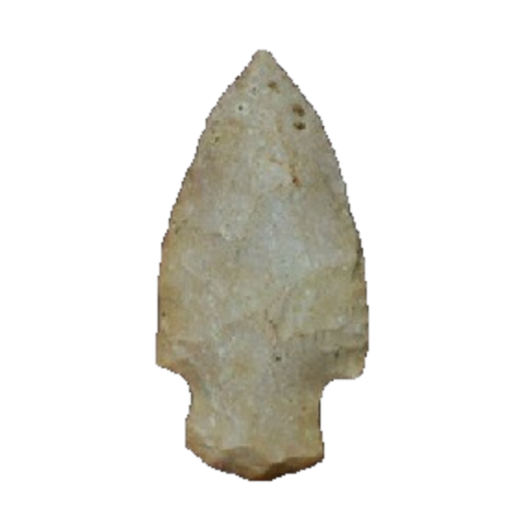
Arrowhead type
Burkett Point
Burkett2,300 - 2,000 B.P.Late Archaic11 reference photos
Key facts
- Age
- 2,300 - 2,000 B.P.
- Cultural period
- Late Archaic
- Size
- Medium
- Shape
- Straight Stem
- Glacial period
- Roman
More from the Archaic period
Description
This triangular point features a stemmed design with a medium size and an elliptical profile. Its blade exhibits a broad shape, characterized by a subtle curvature that can range from a gentle outward sweep to a straight edge. The shoulders of the point are generally aligned horizontally, although they may display a slight inclination, either curving outward in a barbed manner or angling upward to a limited degree. The stem itself can be straight or exhibit a slight contraction, terminating in a base that is either straight or convexly curved. The flaking pattern observed on this point is random, lacking a discernible order or orientation.
Size
The dimensions of the arrowheads are as follows: they exhibit a total length ranging from 50 to 65 mm, with the stem portion measuring between 5 to 15 mm in length. The width of the blade spans 25 to 40 mm, while the stem width varies from 15 to 25 mm, based on an analysis of a limited dataset.
Distribution
This type is mainly discovered in the southern Illinois region of the Ohio-Mississippi river junction of Indiana, Missouri, and Arkansas
Additional information
More information needed.
Identified by
- Named by
- J. Raymond Williams
- Year
- 1974
- Type site
- Burkett Site, Mississippi County, Missouri
Similar types
Types that are easy to confuse with the Burkett point.