
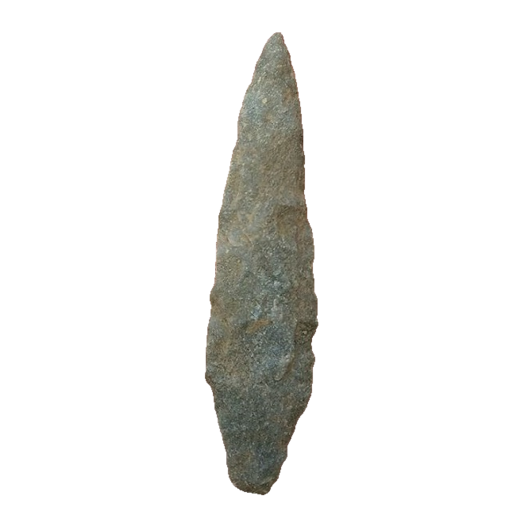
Arrowhead type
Poplar Island Point
Poplar IslandDickson Contracting Stem Cluster3,500 - 2,000 B.P.Middle Archaic to Early Woodland17 reference photos
Key facts
- Age
- 3,500 - 2,000 B.P.
- Cultural period
- Middle Archaic to Early Woodland
- Size
- Medium to Large
- Shape
- Contracting Stem to Straight Stem
- Material
- Quartz
- Glacial period
- Neoglacial to Roman Warm
Description
This lanceolate point exhibits a medium to large size, characterized by a contracting stem and an elliptical cross-sectional profile. The blade morphology ranges from straight to excurvate, often displaying symmetry and a narrow width. The shoulders are typically subdued or absent, with a gentle, upward curvature and rounded edges. The stem tapers inward, terminating in a base that can be either rounded or pointed, with a convex outline. The flaking pattern on this point is random, lacking a discernible order or orientation.
Size
The dimensions of these arrowheads are characterized by the following measurements: overall length ranges from 40 to 120 mm, with a typical average length of 50 to 70 mm. The stem portion measures between 11 and 33 mm in length. In terms of width, the blade spans 18 to 35 mm, while the stem is narrower, ranging from 10 to 22 mm. The thickness of the arrowheads varies from 5 to 23 mm, with an average thickness of less than 11 mm.
Distribution
These artifacts occur from northern Virginia, spanning the Potomac River Basin and extending into the Susquehanna River basin. They are also discovered throughout the Hudson River basin and into the White Clay Creek and Brandywine river basins of Delaware.
Additional information
In a comparative analysis of Native American arrowhead types, this particular point exhibits distinct characteristics that set it apart from similar forms. Notably, the shoulders of this point are less sharply defined than those of the Morrow Mountain point, a type with which it shares some similarities. Furthermore, the base of this arrowhead is more convex in shape, differing from the Morrow Mountain point (classified as W10), which presents a more subtle curvature at its base.
A cross-regional comparison reveals that this point bears some resemblance to the Schuylkill point, a type predominantly found in eastern Pennsylvania. However, upon closer inspection, it becomes apparent that the shoulders of this point are more rounded and less angular than those of the Schuylkill point. This subtle distinction in shoulder morphology suggests that, despite shared characteristics, this point represents a unique variant within the broader context of Native American arrowhead typology.
The observed differences in shoulder definition and base convexity underscore the importance of meticulous analysis in arrowhead classification. By examining these subtle variations, archaeologists can gain a deeper understanding of the technological, cultural, and geographical factors that influenced the development of distinct arrowhead types across different regions. This, in turn, can provide valuable insights into the lives and traditions of the Native American communities that crafted these artifacts, highlighting the complexity and diversity of their technological and cultural expressions.
Identified by
- Named by
- John Witthoft and William A. Richie
- Year
- 1959
- Type site
- Accokeek Creek Site, Maryland
Similar types
Types that are easy to confuse with the Poplar Island point.