
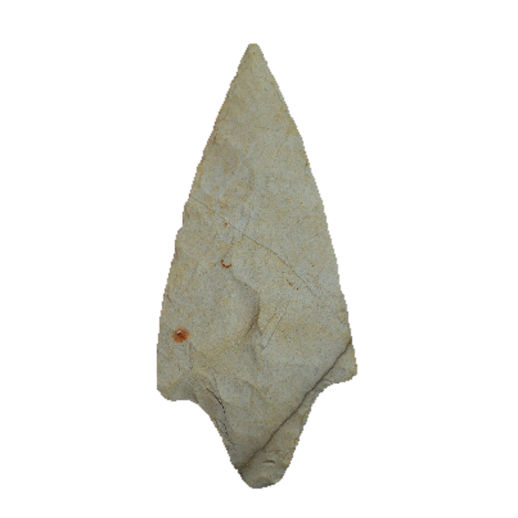
Arrowhead type
Camden Point
CamdenDickson Contracting Stem Cluster3,500 - 1,900 B.P.Late Archaic to Early Woodland13 reference photos
Key facts
- Age
- 3,500 - 1,900 B.P.
- Cultural period
- Late Archaic to Early Woodland
- Size
- Medium to Large
- Shape
- Contracting Stem
- Glacial period
- Neoglacial to Roman Warm
Description
This triangular point exhibits a distinctive morphology, characterized by a medium to large size and a tapering stem. Its cross-sectional profile is elliptical, while the blade itself is marked by a broad, outwardly curved (excurvate) shape. The shoulders are notably wide, displaying a range of configurations from subtly barbed to nearly horizontal. The stem, which contracts in width, may terminate in a pointed base. Notable for its craftsmanship, this point tends to be more slender than comparable variants. The flaking pattern observed on this point is random, lacking a discernible, organized arrangement.
Size
Medium to Large
Distribution
These artifacts are scattered throughout the central to southern Mississippi River Valley, with the greatest densities occurring in Texas, Oklahoma, Louisiana, and Arkansas
Mainly found in
Additional information
In the realm of Native American arrowheads, a distinctive type has been identified, characterized by its broad point and well-defined shoulders. Notably, the base of this arrowhead type exhibits a range of shapes, from rounded to pointed. This specific morphological classification falls under the Gary Type A category, a widely recognized taxonomy in the field of archaeology. The presence of wide shoulders and a varied base shape are key diagnostic features that distinguish this type from others, highlighting the diversity and complexity of Native American lithic technology.
The Gary Type A classification is significant, as it provides a framework for understanding the technological and cultural developments of Native American groups. By examining the characteristics of this arrowhead type, researchers can gain insights into the lives and traditions of the people who crafted and utilized these tools. The broad point and well-defined shoulders of the Gary Type A arrowhead suggest a high degree of craftsmanship and attention to detail, underscoring the importance of lithic technology in the daily lives of Native American communities.
Further study of the Gary Type A arrowhead can reveal valuable information about the cultural and historical contexts in which it was created. By analyzing the distribution, morphology, and chronological placement of this arrowhead type, archaeologists can reconstruct the technological, social, and economic dynamics of Native American societies, ultimately enhancing our understanding of the rich and diverse cultural heritage of these communities. As a result, the Gary Type A arrowhead serves as a significant artifact, offering a unique window into the past and highlighting the sophistication and ingenuity of Native American lithic technology.
Identified by
- Named by
- Frank Shambach
- Year
- 1958
Similar types
Types that are easy to confuse with the Camden point.
Other types in the Dickson Contracting Stem Cluster
- Adena Dickson
- Little Bear Creek
- Poplar Island
- Rossville