
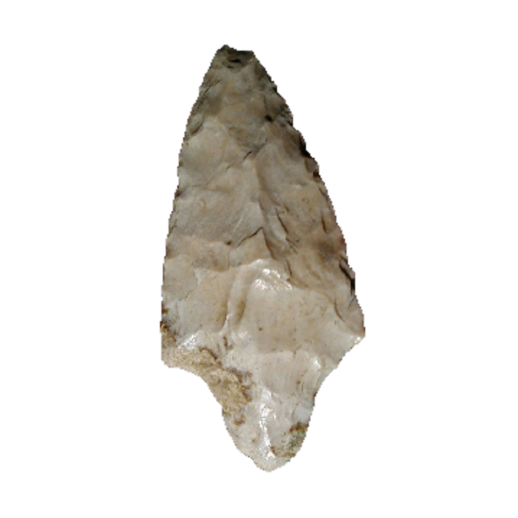
Arrowhead type
Maybon Point
MaybonDickson Contracting Stem Cluster3,500 - 1,900 B.P.Late Archaic to Early Woodland11 reference photos
Key facts
- Age
- 3,500 - 1,900 B.P.
- Cultural period
- Late Archaic to Early Woodland
- Size
- Medium to Large
- Shape
- Contracting Stem
- Glacial period
- Neoglacial to Medieval Warm
Description
This triangular point exhibits a size range of 1.5 to 3.25 inches, characterized by a contracting stem and an elliptical cross-sectional profile. The blade morphology varies, presenting a range of forms from straight to excurvate, with some specimens displaying an incurvate shape. The shoulder configuration is equally diverse, spanning from slightly barbed to horizontal, and in some cases, tapering upward. The stem, typically contracting, may terminate in a pointed base or, conversely, exhibit a slightly expanding form with a convex base. The flaking pattern observed on this point is random, lacking a discernible, organized arrangement.
Size
The dimensions of the arrowheads are as follows: they range in length from 27 to 67 mm, with a mean length of 55 mm. In terms of width, they measure between 15 and 23 mm, averaging 18 mm. The thickness of the arrowheads varies from 4 to 11 mm, with an average thickness of 8 mm.
Distribution
These artifacts are scattered throughout the central to southern Mississippi River Valley, with the greatest densities occurring in Texas, Oklahoma, Louisiana, and Arkansas
Mainly found in
Additional information
In the realm of Native American arrowheads, a distinct point type exhibits notable characteristics, drawing parallels with the Camden variation. One of its defining features is the presence of well-pronounced shoulders, which provide a clear delineation from the rest of the point. However, this point type deviates from the Camden variation in terms of its blade width, which is decidedly narrower. Additionally, its thickness is generally greater, setting it apart from other point types. When classified according to the Gary typology, this point can be categorized as either Class A or Class B, highlighting its nuanced position within the broader context of arrowhead taxonomy.
The combination of a narrow blade and pronounced shoulders on this point type suggests a specific functional adaptation, potentially optimized for hunting or warfare. The increased thickness may have provided added durability, allowing the point to withstand the stresses of impact and penetration. The classification of this point as either Gary Class A or Class B underscores the complexities of arrowhead typology, where subtle variations in form and morphology can significantly impact our understanding of cultural and technological developments.
Further examination of this point type reveals the importance of considering multiple characteristics when attempting to classify and understand Native American arrowheads. By analyzing the interplay between shoulder morphology, blade width, and thickness, researchers can gain valuable insights into the technological and cultural contexts in which these points were created and used. As such, this point type offers a fascinating case study in the nuances of arrowhead design and the ongoing efforts to refine our understanding of Native American material culture.
Identified by
- Named by
- Stephen Williams and Jeffery P. Brian
- Year
- 1983
- Type site
- Lake George Site, Yazoo County, Mississippi
Similar types
Types that are easy to confuse with the Maybon point.
- Adena Wells
- Almagre
- Coahuila
- Hidden Valley
- Morrow Mountain
- Wells