
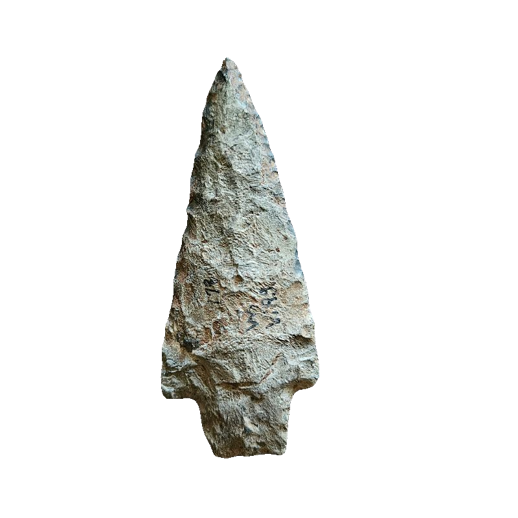
Arrowhead type
Hidden Valley Point
Hidden Valley9,000 - 7,500 B.P.Early Archaic to Middle Archaic12 reference photos
Key facts
- Age
- 9,000 - 7,500 B.P.
- Cultural period
- Early Archaic to Middle Archaic
- Size
- Medium to Large
- Shape
- Contracting Stem
- Glacial period
- Early to Middle Holocene
More from the Archaic period
Description
This triangular point exhibits a distinctive morphology, characterized by a stemmed configuration that tapers towards the base. Its cross-sectional profile is flattened, providing a stable platform for the elongated blade, which can range in curvature from straight to incurvate, with some specimens displaying an excurvate to recurvate shape. Upon re-sharpening, the blade often features left beveling and fine serrations, whereas unmodified examples typically retain barbed shoulders that may be reduced or even absent in re-sharpened specimens. The stem itself is notable for its elongated and contracting shape, with evidence of thinning on one or both sides, occasionally creating the illusion of short flutes. A concave base is a consistent characteristic of this point type, unless compromised by damage. The flaking pattern observed on this point is random, lacking a deliberate or organized arrangement.
Size
The dimensions of the arrowheads are as follows: they range in overall length from 60 to 110 mm, with stem lengths varying between 13 and 17 mm. The width of the blade spans from 30 to 45 mm, while the stem width at the shoulders measures between 18 and 25 mm. Additionally, the basal width is recorded to be within the range of 13 to 18 mm, based on an analysis of a limited dataset.
Distribution
This arrowhead type is mainly located above the North Ozark Divide in Missouri, yet can also be discovered throughout Missouri's Ozark area. It is seldom encountered in Missouri beyond the Ozark territory. The presence of this point has been documented in Indiana's American Bottoms region (Higgins, 1990). Additionally, Morrows has identified this type in southeastern Iowa's borders
Also found, less often, in
Additional information
In the realm of Native American arrowheads, the Hidden Valley point is a notable specimen that exhibits distinct characteristics. One of its defining features is the pronounced grinding evident in the basal and hafting regions, a trait that may have been inherited from the Paleo period, which dates back to around 12,000 to 10,000 years ago. This type of point shares many similarities with the more recent Standlee point, with the primary difference being the extent of basal and hafting region grinding, which is typically light in the case of the Standlee point.
A comparison with the Dickson point reveals further insights into the characteristics of the Hidden Valley point. While both points share some similarities, the Dickson point is distinguished by its use of heat-treated materials, resulting in a thinner and more refined profile. Additionally, the Dickson point often lacks the heavy basal and hafting region grinding that is characteristic of the Hidden Valley point. This suggests that the Hidden Valley point may have been manufactured using different techniques or materials, which could be attributed to its older age. The absence of heat-treated materials in the Hidden Valley point is a notable aspect, as it implies a more traditional or primitive method of production.
The Hidden Valley point's thicker profile and heavy basal and hafting region grinding are testament to its unique cultural and historical context. As an older point, it provides valuable insights into the technological and manufacturing practices of its time. By examining the characteristics of the Hidden Valley point, archaeologists can gain a deeper understanding of the evolution of arrowhead design and the cultural exchange networks that existed among Native American communities. The study of this point highlights the importance of considering the technological, cultural, and historical factors that shaped the development of Native American arrowheads, and underscores the significance of preserving and interpreting these artifacts for future generations.
Identified by
- Named by
- Robert McCormick Adams
- Year
- 1941
- Type site
- Hidden Valley Rock Shelter, Jefferson Missouri
Similar types
Types that are easy to confuse with the Hidden Valley point.
- Adena Dickson
- Gary
- Langtry
- Kirk Stemmed
- Mason Contracting Stem
- Morrow Mountain
- Pogo
- Searcy