
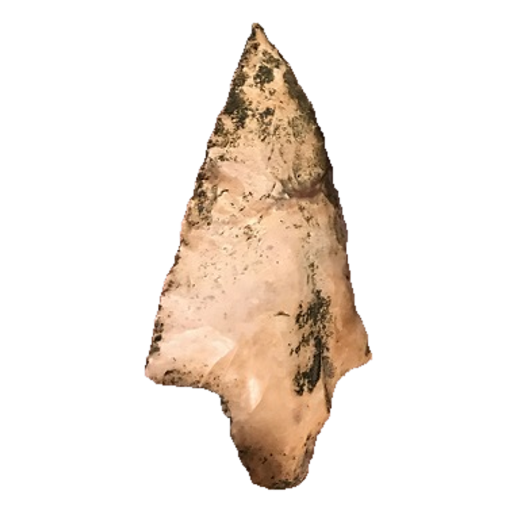
Arrowhead type
Dickson Point
DicksonDickson Contracting Stem Cluster3,000 - 1,300 B.P.Late Archaic to Woodland24 reference photos
Key facts
- Age
- 3,000 - 1,300 B.P.
- Cultural period
- Late Archaic to Woodland
- Culture
- Black Sand and Havana Hopewell cultures
- Size
- Medium to Large
- Shape
- Contracting Stem to Straight Stem
- Glacial period
- Neoglacial to Roman Warm
Description
This triangular point features a slender, medium to large profile with a contracting stem and a cross-section that is notably flattened. The blade's outline is predominantly straight or excurvate, although some specimens exhibit an incurvate form. A distinctive characteristic of the blade is the presence of alternate bevel re-sharpening, which suggests repeated use and maintenance. The base and stem of the point often display moderate grinding, indicative of deliberate edge smoothing. The shoulders of the point typically rise at an upward angle, but can also be found with a horizontal orientation or a slight downward slope. The stem tapers inward, and the base varies from straight to slightly concave, sometimes presenting a squarish or truncated appearance due to thinning. The manufacturing technique employed is random percussion flaking, supplemented by marginal pressure retouching that yields a random, yet deliberate, flaking pattern. Overall, the workmanship on these points is of high quality, reflecting a careful and skilled approach to their production.
Size
The dimensions of the arrowheads are as follows: they range in overall length from 50 to 150 mm, with stem lengths varying between 15 and 25 mm. The width of the blade spans from 30 to 55 mm, while the stem width at the shoulders measures between 15 and 25 mm. Additionally, the basal width is recorded to be between 8 and 15 mm.
Distribution
These artifacts predominantly occur in the Illinois and Kaskaskia River basins, with diminishing presence extending into Indiana, Michigan, and Wisconsin, yet can also appear throughout the Ohio River basin and into the Tennessee and Mississippi River basins. They can also be discovered with reduced regularity in additional notable regions
Additional information
The arrowhead types found in this particular cluster have a notable temporal range, spanning from the late Archaic period to the early and middle Woodland period, as documented by Justice in 1987. This timeframe is significant, as it highlights the enduring utility and popularity of these point styles across multiple cultural phases. Notably, the point in question is a characteristic artifact of the Hopewell Culture, a complex and influential Native American culture known for its sophisticated earthen mounds and trade networks.
It is essential to clarify the cultural context of this arrowhead, as it is often mistakenly attributed to the Adena culture. While both the Hopewell and Adena cultures were prominent during the Eastern Woodlands period, they are distinct and had unique characteristics. The Hopewell Culture, which flourished from around 200 BCE to 500 CE, is renowned for its elaborate ceremonial centers and extensive exchange networks. In contrast, the Adena culture, which dates from approximately 1000 BCE to 100 CE, is characterized by its earthen mounds and distinctive artifact styles. By recognizing the correct cultural affiliation of this arrowhead, we can gain a deeper understanding of the technological, social, and cultural developments of the Hopewell people during this period.
The study of arrowheads like this one offers valuable insights into the lives and traditions of Native American communities, highlighting their resourcefulness, adaptability, and craftsmanship. By examining the design, materials, and production techniques of these artifacts, archaeologists can reconstruct the cultural, economic, and environmental contexts in which they were created and used. As such, this arrowhead serves as a tangible link to the past, providing a window into the experiences and achievements of the Hopewell people and their place within the broader narrative of Native American history.
Identified by
- Named by
- Howard D. Winters
- Year
- 1967
- Type site
- The Pond and Dickson Camp Site (Fv35-P and Fv35D), Dickson Mound Site, Fulton Cunty, Illinois
Similar types
Types that are easy to confuse with the Dickson point.
- Burkett
- Coahuila
- Cypress Creek
- Hidden Valley
- Langtry
- Marion
- Morrow Mountain
- New Market
- Newnan
Other types in the Dickson Contracting Stem Cluster
- Adena
- Belknap
- Gary
- Little Bear Creek
- Poplar Island
- Rossville
- Waubesa