
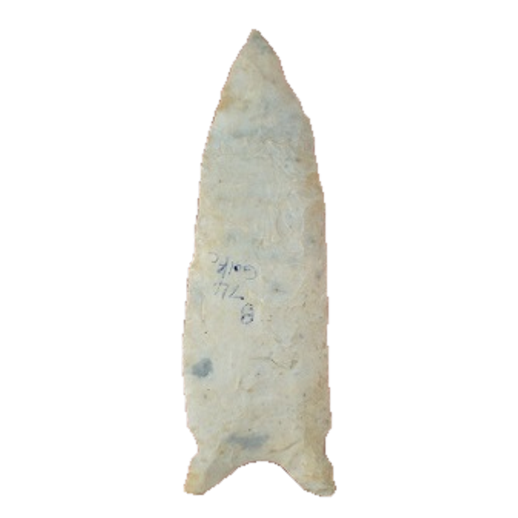
Arrowhead type
Dalton Greenbrier Point
Dalton GreenbrierDalton Cluster10,500 - 8,500 B.P.Transitional Paleo to Early Archaic23 reference photos
Key facts
- Age
- 10,500 - 8,500 B.P.
- Cultural period
- Transitional Paleo to Early Archaic
- Size
- Medium to Large
- Shape
- Auriculate to Lanceolate
- Glacial period
- Early Holocene
Description
This auriculate point exhibits a medium to large size profile, characterized by a cross-sectional shape that varies between elliptical and rhomboid contours. The blade itself is predominantly straight, although it may exhibit a subtle excurvate curvature approaching the hafting area. A distinctive feature of this point is the presence of fine serrations along the blade's edge, which are a common occurrence. The notches are notable for their broad and shallow morphology, resulting in weakly defined shoulders that slope upward. The hafting area is marked by a rectangular, concave recess on the blade, giving rise to the characteristic auriculate "ears." The base of the point is concave, and both the base and hafting area often display evidence of heavy grinding and thinning. The blade's serrated edge is a prevalent trait, while the flaking pattern appears to be random, lacking a discernible pattern or orientation.
Size
The dimensions of the arrowheads are characterized by the following measurements: overall length ranges from 35 to 90 mm, while the stem length spans 10 to 20 mm. The blade itself exhibits a width of 20 to 30 mm. Additionally, the neck or waist width measures between 18 and 30 mm, and the basal width falls within the same range of 20 to 30 mm.
Distribution
This point occurs extensively throughout the Tennessee River Valley and extends into the Blue Ridge areas, the southern Mississippi Valley, and onwards into the Gulf coast states
Additional information
More information needed.
Identified by
- Named by
- Thomas M. N. Lewis and Madeline Kneberg
- Year
- 1958
- Type site
- Nuckolls Site, Humphrey County, Tennessee
Similar types
Types that are easy to confuse with the Dalton Greenbrier point.
- Arkabutla
- Barnes
- Candy Creek
- Copena Articulated
- Golondrina
- Meserve
- Midland
- Nolichucky
- Pelican
- Plainview
- San Patrice
- Redstone
- Santa Fe
- Suwannee
- Tallahassee
- Wheeler Recurve
Other types in the Dalton Cluster
- Beaver Lake
- Dalton
- Dalton Breckenridge
- Dalton Colbert
- Dalton Hemphill
- Dalton Hempstead
- Dalton Nuckolls
- Dalton Sloan
- Hardaway Dalton
- Hi-Lo
- Quad