
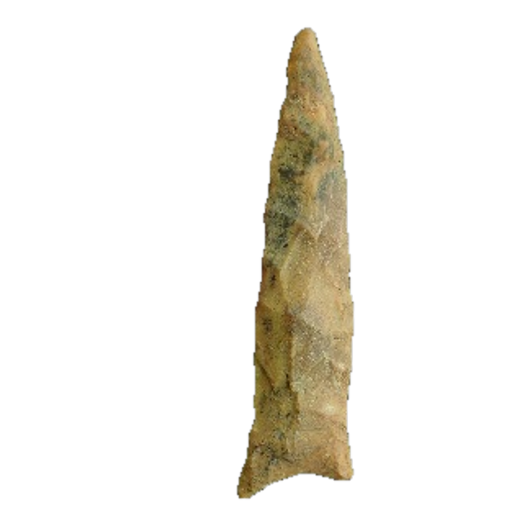
Arrowhead type
Santa Fe Point
Santa Fe3,500 - 2,500 B.P.Late Archaic to Early Woodland18 reference photos
Key facts
- Age
- 3,500 - 2,500 B.P.
- Cultural period
- Late Archaic to Early Woodland
- Size
- Medium
- Shape
- Auriculate to Lanceolate
- Glacial period
- Neoglacial
Description
This triangular auriculate point exhibits a slender profile, measuring between 1.5 to 4 inches in length, with a cross-sectional shape that transitions from elliptical to flattened. The blade's curvature is characterized by an excurvate to recurvate pattern, where the tip is incurved, the midsection straightens, and the base flares outward. Notably, the edge remains unserrated, distinguishing it from Safety Harbor and Tallahassee types. The concave base gives rise to pronounced basal ears, or articulates, that project downward. The hafting area displays minimal grinding, if any. The flaking pattern on this point appears random, yet the overall craftsmanship is of high quality, underscoring the skillful manufacture of this artifact.
Size
The dimensions of the arrowheads are characterized by a total length ranging from 30 to 100 mm, with a mean length typically falling between 45 and 55 mm. The basal width varies between 15 and 32 mm, while the thickness spans from 6 to 9 mm. Additionally, the basal concavity measures between 3 and 7 mm.
Distribution
This type is mainly located in Florida and extends into the southern regions of Georgia and Alabama.
Additional information
The classification and dating of this particular arrowhead type have undergone significant revisions over the years. Initially, it was categorized as a transitional Paleo point, with Bullen (1975) specifically identifying it as a subtype 6 within the Clovis category. Notably, Bullen observed that the emergence of this point type marked the arrival of populations associated with the Dalton Lithic Complex. Prior to the 1990s, the dating of this point was primarily based on its morphological characteristics. However, with the discovery of its association with Norwood fiber-temper ceramics, as reported by Farr (2006), its chronological placement has been reevaluated. Consequently, this point is now dated to the Late Archaic to Early Woodland period, a significant adjustment from its earlier assigned timeframe.
A distinctive feature of this point type is its relatively thinner profile compared to older Dalton-type points. Furthermore, the hafting region of this point exhibits light to absent grinding, a characteristic that differentiates it from Dalton-type points, which typically display heavier grinding in this area. These observations highlight the importance of continued research and refinement in the field of archaeology, as new discoveries and associations can substantially impact our understanding of cultural and technological developments.
The reclassification of this point type to the Late Archaic to Early Woodland period underscores the dynamic nature of archaeological inquiry and the need for ongoing reassessment of existing knowledge. The association with Norwood fiber-temper ceramics has provided a more secure chronological anchor, allowing for a more nuanced understanding of the cultural and technological context in which this point type was produced. As archaeological research continues to evolve, it is likely that further insights will emerge, shedding additional light on the lives and traditions of the populations that created these artifacts.
Identified by
- Named by
- John M. Goggins
- Year
- 1950
Similar types
Types that are easy to confuse with the Santa Fe point.