
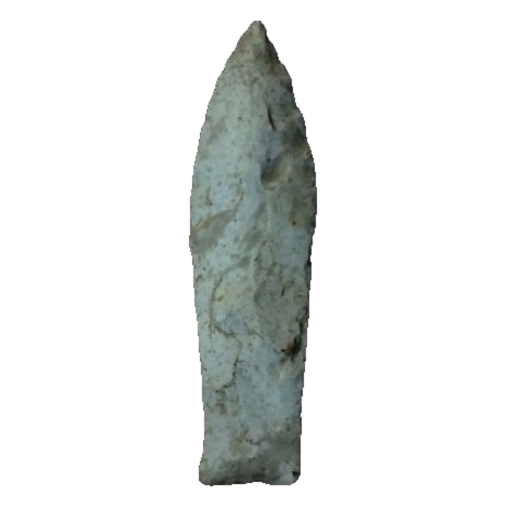
Arrowhead type
Beaver Lake Point
Beaver LakeDalton Cluster10,500 - 9,500 B.P.Transitional Paleo27 reference photos
Key facts
- Age
- 10,500 - 9,500 B.P.
- Cultural period
- Transitional Paleo
- Size
- Medium to Large
- Shape
- Auriculate
- Material
- Limestone
- Glacial period
- Late Pleistocene to Early Holocene
More from the Paleo period
Description
This lanceolate point exhibits a medium to large size, characterized by an auriculate shape. In cross-section, its profile is predominantly elliptical, although a median ridge may be present on one or both sides, adding a subtle longitudinal accent. The blade's curvature is outwardly recurvate, tapering at the waist before expanding towards the base. The base itself is typically concave, but occasionally straight, and may feature basal grinding or thinning, indicative of deliberate edge modification. The flaking pattern is notable for its shallowness, which can result in the formation of a median ridge. Furthermore, secondary re-touching of the blade edge is evident, marked by the removal of longer, evenly spaced flakes from alternating faces, suggesting a deliberate effort to refine the edge. The overall flaking pattern varies, ranging from a predominant random arrangement to a more organized collateral pattern, often accompanied by a median ridge.
Size
The dimensions of these arrowheads are characterized by the following measurements: they range in length from 47 to 86 mm, with a mean length of 64 mm. The blade width varies between 20 and 35 mm, averaging 24 mm. At the waist, the width spans from 15 to 28 mm, with an average of 21 mm. The base width, which exceeds the blade width, measures between 18 and 32 mm, averaging 25 mm. In terms of thickness, these arrowheads are 7 to 9 mm thick. Additionally, the basal concavity is observed to be between 2 and 5 mm, with an average concavity of 3 mm.
Distribution
This type is mainly concentrated in the Tennessee River Valley and occasionally extends into the Ohio River Valley. They are seldom discovered in the Tampa area of Florida and the other designated areas
Additional information
In the realm of Native American archaeology, a particular point of interest has been categorized within the Dalton Complex. However, a notable dissenting opinion was expressed by Justice in 1987, who proposed an alternative perspective. According to Justice, this point may not be an integral part of the Dalton Complex, but rather an extension of the technological traditions associated with the Simpson culture. This distinction highlights the complexities and nuances of archaeological classification, where the evolution of tool-making technologies can sometimes blur the lines between distinct cultural complexes. By examining the characteristics of this point, researchers can gain a deeper understanding of the technological and cultural exchanges that occurred among Native American groups, ultimately shedding light on the dynamic history of these ancient societies.
Identified by
- Named by
- David DeJarnette
- Year
- 1962
- Type site
- Stanfield-Worley Bluff Shelter, Colbert County, Alabama
Similar types
Types that are easy to confuse with the Beaver Lake point.
Other types in the Dalton Cluster
- Dalton
- Dalton Breckenridge
- Dalton Colbert
- Dalton Greenbrier
- Dalton Hemphill
- Dalton Hempstead
- Dalton Nuckolls
- Dalton Sloan
- Hardaway Dalton
- Hi-Lo