
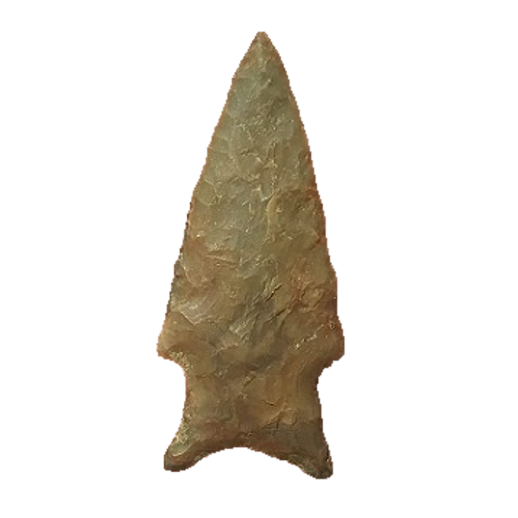
Arrowhead type
Dalton Hemphill Point
Dalton HemphillDalton Cluster10,000 - 8,500 B.P.Transitional Paleo to Early Archaic13 reference photos
Key facts
- Age
- 10,000 - 8,500 B.P.
- Cultural period
- Transitional Paleo to Early Archaic
- Size
- Medium to Large
- Shape
- Auriculate to Lanceolate
- Glacial period
- Early Holocene
Description
This auriculate point exhibits a size range of medium to large, with a cross-sectional profile that can be either elliptical or flattened. The blade itself is generally straight, often featuring serrations along its edge and a beveled shape. A distinctive characteristic of this point is its constricted waist, which can result in shoulders that are either weak, absent, or variably sloped upwards. The base of the point displays a range of concavity, from slight to deep. The area intended for hafting shows evidence of grinding, and both basal grinding and flaking are typical features. In some cases, the basal flaking pattern may create an appearance reminiscent of fluting. The overall flaking pattern on this point can be quite diverse, encompassing oblique transverse, horizontal transverse, collateral, or random arrangements.
Size
The dimensions of the arrowheads are characterized by a total length ranging from 33 to 88 mm, with a mean length of 48 mm, while the average width is 21 mm.
Distribution
This type is discovered throughout the Mississippi River basin and extending into the Illinois River basin and the Red River basin.
Mainly found in
Also found, less often, in
Additional information
The archaeological record reveals a significant development in the evolution of projectile points, culminating in the emergence of the Hemphill point. This distinctive point type represents a notable milestone in the technological and cultural advancements of Native American communities. Characterized by its unique morphology, the Hemphill point is a testament to the ingenuity and adaptability of ancient societies.
As a product of gradual innovation, the Hemphill point reflects the refinement of earlier designs, showcasing a blend of functional efficiency and cultural expression. Its development is a fascinating example of how Native American groups continually improved and refined their tools, driven by the need for effective hunting and self-defense. The Hemphill point's appearance marks a significant turning point in the history of projectile point technology, highlighting the dynamic nature of cultural and technological exchange among indigenous populations.
The Hemphill point's significance extends beyond its functional purpose, offering valuable insights into the social, economic, and environmental contexts of the cultures that created it. By examining the characteristics and distribution of this point type, archaeologists can reconstruct aspects of the lives and traditions of Native American communities, shedding light on their technological, artistic, and spiritual practices. As a window into the past, the Hemphill point serves as a powerful tool for understanding the complexities and diversity of human experience in North America, inviting further research and exploration into the rich cultural heritage of indigenous societies.
Identified by
- Named by
- Edward G. Scully
- Year
- 1951
Similar types
Types that are easy to confuse with the Dalton Hemphill point.
- Arkabutla
- Barnes
- Candy Creek
- Copena Articulated
- Golondrina
- Meserve
- Nolichucky
- Pelican
- Plainview
- San Patrice
- Suwannee
- Wheeler Recurve
Other types in the Dalton Cluster
- Beaver Lake
- Dalton
- Dalton Breckenridge
- Dalton Colbert
- Dalton Greenbrier
- Dalton Hempstead
- Dalton Nuckolls
- Dalton Sloan
- Hardaway Dalton
- Hi-Lo
- Quad