
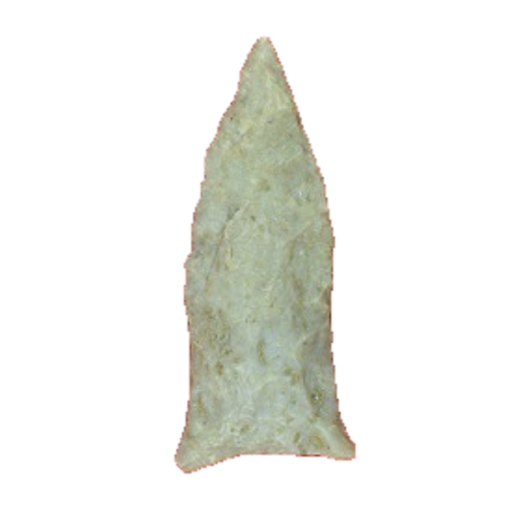
Arrowhead type
Candy Creek Point
Candy CreekCopena Cluster3,000 - 1,500 B.P.Early Woodland to Middle Woodland4 reference photos
Key facts
- Age
- 3,000 - 1,500 B.P.
- Cultural period
- Early Woodland to Middle Woodland
- Size
- Medium
- Shape
- Auriculate to Lanceolate
- Glacial period
- Neoglacial to Little Ice Age
More from the Woodland period
Description
This auriculate point exhibits a medium size and an elliptical profile in cross-section. Its blade displays a distinctive outward recurvate shape, characterized by an inward curve at the distal end and a pronounced flare at the proximal base. The basal morphology is predominantly concave, although it can vary to a straight configuration in some instances. Additionally, the base may feature basal thinning or exhibit a fluted appearance, resulting from the removal of flakes. The flaking pattern observed on this point is random, lacking a discernible pattern or orientation.
Size
The dimensions of these arrowheads are characterized by a total length ranging from 30 to 65 mm, with an average measurement of 50 mm. The width of the blade spans 18 to 35 mm. Notably, the waist width is consistently 3 to 5 mm less than the blade width. In contrast, the basal width is 3 to 5 mm greater than the blade width, providing a distinct proportional relationship among these key dimensions.
Distribution
This type is mainly located in the Tennessee River Valley region.
Also found, less often, in
Additional information
In the realm of Native American archaeology, it is essential to accurately identify and distinguish between various types of arrowheads. One notable point type, often subject to misidentification, can be readily discerned from Paleo points by a distinct characteristic. Specifically, this point lacks parallel flaking, a trait commonly associated with Paleo points. This diagnostic feature allows archaeologists to confidently differentiate between these two point types, ensuring a more precise understanding of the cultural and temporal contexts in which they were crafted.
The absence of parallel flaking on this point type is a significant characteristic, as it suggests a unique manufacturing approach and technological tradition. By recognizing this distinction, researchers can gain valuable insights into the lives and traditions of the Native American groups who created these arrowheads. Furthermore, this characteristic can inform our understanding of the cultural exchange networks, technological developments, and adaptive strategies employed by these communities. As such, careful examination and identification of arrowhead types, including this point, are crucial for reconstructing the complex and dynamic histories of Native American cultures.
Through meticulous analysis and comparison of archaeological specimens, researchers can continue to refine our understanding of the diverse technological and cultural traditions that shaped the lives of Native American communities. By acknowledging and building upon the distinct characteristics of various arrowhead types, including the point in question, archaeologists can work towards a more nuanced and comprehensive appreciation of the rich cultural heritage of Native American societies. This, in turn, can inform our broader understanding of human history, cultural diversity, and the complex interactions between technology, environment, and society.
Identified by
- Named by
- T.M.N. Lewis and Madeline Kneberg
- Year
- 1956
- Type site
- Candy Creek site, Bradley County, Tennessee
Similar types
Types that are easy to confuse with the Candy Creek point.
- Arkabutla
- Beaver Lake
- Camp Creek
- Copena
- Dalton
- Nolichucky
- Quad
Other types in the Copena Cluster
- Copena Articulated
- Copena Round Base
- Copena Triangular