
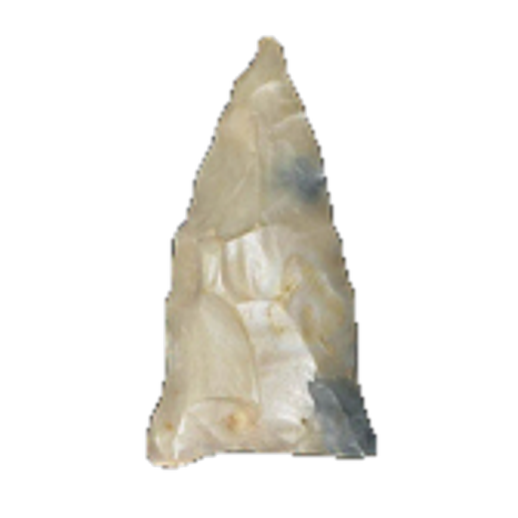
Arrowhead type
Nolichucky Point
NolichuckyCopena Cluster2,000 - 1,500 B.P.Woodland2 reference photos
Key facts
- Age
- 2,000 - 1,500 B.P.
- Cultural period
- Woodland
- Size
- Small to Medium
- Shape
- Auriculate to Lanceolate to Triangle
- Glacial period
- Roman Warm
More from the Woodland period
Description
This auriculate point measures between 1 to 2 inches in length and exhibits an elliptical profile. The blade's curvature can range from excurvate to straight, while the hafting area may display an incurvate to straight alignment. Characteristic of this point style, the base expands to form distinctive articulations, or "ears." The basal edge can be concave, although it may also appear straight in some instances. A notable feature of this point is the presence of basal thinning, which is a common trait. The flaking pattern observed on this specimen is random, lacking a discernible or consistent pattern.
Size
The arrowhead's dimensions are characterized by the following average measurements: a total length of 37 mm, a blade width of 16 mm, a base width of 17 mm, a neck width of 15 mm, and a thickness of 6 mm.
Distribution
This type is mainly located in the northern to central regions of the Tennessee River valley.
Mainly found in
Additional information
More information needed.
Identified by
- Named by
- Madeline Kneberg
- Year
- 1957
- Type site
- Camp Creek Site, Greene County, Tennessee
Similar types
Types that are easy to confuse with the Nolichucky point.
- Camp Creek
- Candy Creek
- Copena
- Greenville
- Yadkin
Other types in the Copena Cluster
- Copena Articulated
- Copena Round Base
- Copena Triangular