
Arrowhead type
Tallahassee Point
TallahasseeLate Woodland Triangle Cluster to Early Mississippian Triangle Cluster2,500 - 2,000 B.P.Early Woodland to Middle Woodland13 reference photos
Key facts
- Age
- 2,500 - 2,000 B.P.
- Cultural period
- Early Woodland to Middle Woodland
- Size
- Medium
- Shape
- Auriculate to Lanceolate
- Glacial period
- Roman Warm
More from the Woodland period
Description
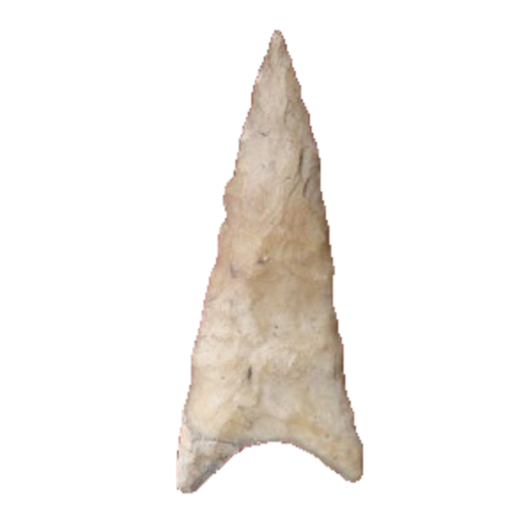
This triangular point exhibits a slender profile, measuring between 1.75 and 3.25 inches in length, with a cross-sectional shape that ranges from elliptical to flattened. The blade itself is elongated and narrow, featuring an edge that curves outward, transitioning from an excurvate to a recurvate shape as it approaches the tip, while flaring outward at the base. Serrations are present along the entire length of the blade, extending from the hafting area to the distal tip. The base of the point is characterized by a concave shape, giving rise to a pair of auricles, or basal ears, that project downward. The hafting region displays minimal grinding, if any. The flaking pattern observed on this point is random, lacking a discernible or deliberate arrangement.
Size
The dimensions of the arrowheads are characterized by the following measurements: overall length ranges from 33 to 85 mm, with a typical average span of 45 to 55 mm. The width at the base varies between 15 and 30 mm, averaging between 22 and 25 mm. The basal concavity, which is the inward curvature at the base, measures between 2 and 7 mm, with an average of 4 mm. Additionally, the thickness of the arrowheads falls within a range of 5 to 7 mm.
Distribution
This type is mainly discovered in northeastern Florida, extending into southeastern Georgia and southwestern Alabama
Additional information
The arrowhead type in question is often linked to the Transitional Paleo or Early Archaic periods, highlighting its significance in the context of Native American cultural development. Notably, archaeological findings have also revealed associations with the Woodland period, as evidenced by discoveries at the Block-Stearns Site and the Oconi Mission site in Jefferson County, Florida, where these points were found in conjunction with ceramic artifacts (Farr, 2006). A distinctive characteristic of this point type is its relatively slender profile, which sets it apart from the more robust Dalton type points that precede it.
Further examination of these points reveals a notable difference in the hafting region, where the grinding is either minimal or entirely absent. In contrast, Dalton type points typically exhibit more pronounced grinding in this area, suggesting a variation in manufacturing techniques or functional requirements. The work of Whatley (2002) provides additional insight, as it identifies this point type as being equivalent to the Safety Harbor point, a designation specific to the Florida region. This equivalence underscores the importance of considering regional variations and cultural exchange networks in the classification and understanding of Native American arrowhead types.
The combination of these characteristics and associations provides a more nuanced understanding of the cultural and chronological context in which these arrowheads were produced and used. By recognizing the similarities and differences between this point type and others, such as the Dalton, researchers can refine their understanding of the technological, social, and economic factors that influenced the development of stone tool traditions among Native American communities. Furthermore, the presence of these points at specific sites, like the Block-Stearns and Oconi Mission sites, highlights the value of archaeological research in reconstructing the lives and interactions of past cultures, and underscores the need for continued investigation into the complexities of Native American cultural heritage.
Identified by
- Named by
- Wilfred T. Neill
- Year
- 1963
Similar types
Types that are easy to confuse with the Tallahassee point.