
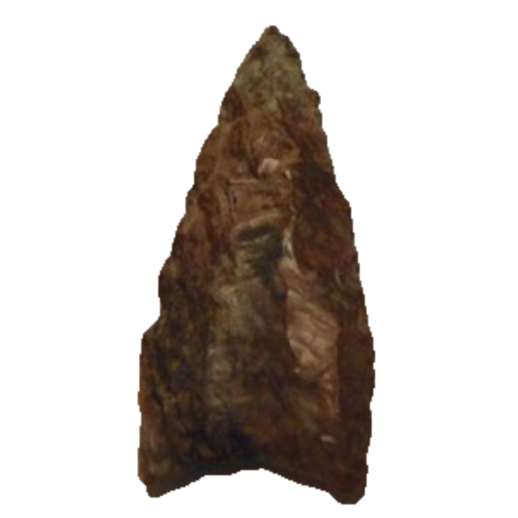
Arrowhead type
Redstone Point
RedstoneClovis Cluster13,000 - 11,000 B.P.Late Paleo4 reference photos
Key facts
- Age
- 13,000 - 11,000 B.P.
- Cultural period
- Late Paleo
- Size
- Medium to Large
- Shape
- Auriculate to Lanceolate
- Material
- Agate
- Glacial period
- Late Pleistocene
More from the Paleo period
Description
This triangular point exhibits a medium to large size profile, characterized by a cross-sectional morphology that is notably flattened. The blade's longitudinal outline can range from a straight alignment to a subtle, outward curvature. A distinctive concavity defines the base of the point. The presence of fluting is a notable feature, with either a single or multiple flutes evident on each facial surface. A significant aspect of the point's manufacture is the application of basal and lateral grinding, which typically encompasses the lower third of the artifact. The flaking pattern observed on this point is generally randomized, lacking a consistent or directional orientation.
Size
The arrowheads exhibit the following dimensional characteristics: overall length ranges from 67 to 117 mm, with a mean length of 89 mm. The average blade width is 37 mm, while the average thickness is 7 mm. Additionally, the basal concavity measures 9 mm on average. The flute length varies between 26 and 70 mm.
Distribution
This type is mainly located in the Tennessee River basin and extends into the Ohio River basin and central Mississippi River basin. It can also be discovered in the Red River Valley of Oklahoma and Texas, as well as the Piedmont and coastal areas of the Carolinas. Occasionally, these types have been uncovered in southern Georgia and northern Florida
Additional information
In the realm of Native American arrowhead typology, a particular point of interest exhibits characteristics that distinguish it from its counterparts, while also sharing certain affinities with other known types. Notably, this point bears a resemblance to the Beaver Lake point, but with some key differences, including a shorter and broader shape, as well as more pronounced "ears." The evolutionary relationships between this point and other established types, such as the Clovis and Dalton points, are still a subject of debate among archaeologists.
Some researchers propose that this point may occupy a transitional position between the earlier Clovis point, which dates back to the Paleoindian period, and the later Dalton point, which is associated with the Early Archaic period. This would suggest a chronological sequence in which this point represents a intermediate stage in the development of arrowhead technology. Alternatively, other scholars argue that this point may have evolved from the Simpson point, eventually giving rise to the Beaver Lake point, or possibly originating from the Cumberland point and later influencing the development of the Beaver Lake point. These competing theories highlight the complexities and nuances of Native American arrowhead typology, underscoring the need for continued research and analysis to clarify the relationships between these various point types.
The study of this point and its potential connections to other arrowhead types offers valuable insights into the technological, cultural, and historical contexts of Native American communities. By examining the morphological characteristics and potential evolutionary relationships of this point, archaeologists can gain a deeper understanding of the dynamics of cultural exchange, technological innovation, and adaptation that shaped the lives of indigenous peoples in North America. Further investigation and comparison of this point with other established types, such as the Clovis, Dalton, Simpson, and Cumberland points, will be essential in resolving the uncertainties surrounding its origins and significance, ultimately contributing to a more comprehensive and refined understanding of Native American arrowhead typology.
Identified by
- Named by
- Edward C. Mahon
- Year
- 1964
- Type site
- Madison County, Alabama
Similar types
Types that are easy to confuse with the Redstone point.
- Agate Basin
- Angostura
- Alder
- Barber
- Bat Cave
- Belen
- Black Rock
- Barnes
- Beaver Lake
- Browns Valley
- Conerly
- Copena Articulated
- Crowfield
- Cumberland
- Dalton
- Golondrina
- Fayette
- Folsom
- Fredrick
- Lovell
- Midland
- Northumberland
- Simpson
- Suwannee
- Union
- Wheeler
Other types in the Clovis Cluster
- Clovis
- Clovis Hazel
- Clovis St Louis
- Clovis Tulare Lake
- Clovis Un-fluted
- Debert
- Holcombe