
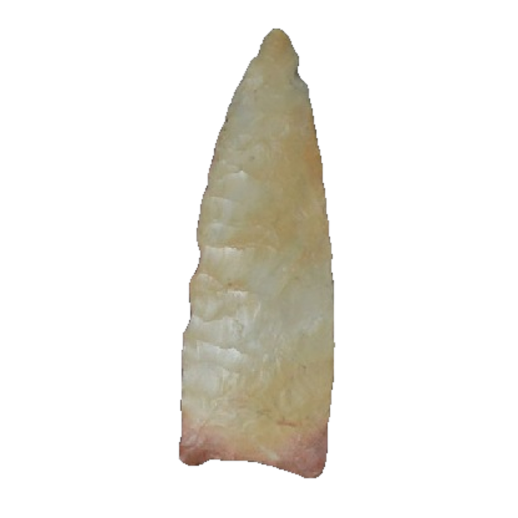
Arrowhead type
Plainview Point
PlainviewPlano Lanceolate Cluster10,000 - 9,000 B.P.Transitional Paleo18 reference photos
Key facts
- Age
- 10,000 - 9,000 B.P.
- Cultural period
- Transitional Paleo
- Size
- Medium to Large
- Shape
- Auriculate to Lanceolate
- Glacial period
- Late Pleistocene to Early Holocene
More from the Paleo period
Description
This lanceolate point typically measures between 2.5 and 3.5 inches in length, exhibiting a cross-sectional profile that ranges from flattened to elliptical, with some specimens featuring a median ridge. The blade's morphology is characterized by an excurvate curvature towards the apex, accompanied by parallel sides. The lower portion of the blade is generally straight, although some examples may display a subtle auriculate curvature. In contrast, the upper portion of the blade often converges to form a sharply defined tip. The base of the point can vary in concavity, ranging from slight to deep. The basal edge and hafting area frequently exhibit evidence of grinding, often accompanied by the removal of long, thin flakes. The manufacturing process involves an initial stage of percussion flaking to rough out the preform, followed by precise pressure flaking that yields a flaking pattern ranging from transverse parallel to collateral.
Size
The dimensions of these arrowheads are characterized by a total length ranging from 45 to 95 mm, with the blade width measuring between 18 and 28 mm. The base of the arrowhead spans 20 to 26 mm in width, and exhibits a basal concavity of 1 to 8 mm, as outlined in the measurements established by Suhm and Krieger (1954).
Distribution
This arrowhead is typically discovered in the grasslands spanning from Texas to Alberta. It appears with decreased regularity in the shaded zones beyond the grasslands area. This variety has also been identified in the Mexico Valley and Tehuacan Valley of Mexico.
Additional information
The archaeological record reveals a fascinating connection between a particular type of projectile point and the western bison hunting tradition, as noted by Justice in 1987. Excavations at the Lake Theo site have unearthed these points in stratigraphic layers situated between Folsom and Archaic deposits, suggesting a specific temporal context. Furthermore, research by Justice (1987) indicates that these points share affinities with Dalton points, highlighting a potential cultural and technological relationship.
In a separate study, Joel D. Gunn (1984) identified a distinct point type at Fort Polk, Texas, which he termed the Coastview point. However, subsequent research by Anderson et al. (2002) led to the reclassification of these points as Plainview, rendering the Coastview designation redundant. As a result, it has been proposed that the name Coastview be discontinued in favor of the more accurate Plainview designation. Notably, these points exhibit similarities with Goshen points, although the latter are believed to represent an earlier point type, as observed by Boszhardt in 2003. This distinction underscores the complex and nuanced nature of projectile point typology, highlighting the importance of careful analysis and classification in understanding the cultural and chronological contexts of these artifacts.
The study of these projectile points offers valuable insights into the technological and cultural developments of Native American groups, particularly in relation to the western bison hunting tradition. By examining the morphological characteristics, stratigraphic positioning, and cultural associations of these points, researchers can reconstruct a more detailed picture of the lives and traditions of these ancient communities. The identification of point types, such as Plainview and Goshen, serves as a crucial tool in this endeavor, enabling archaeologists to trace the evolution of technological and cultural practices over time and across different regions.
Identified by
- Named by
- Elisa H. Sellards
- Year
- 1947
- Type site
- Plainview Site (near Plainview Texas), Running Water Draw, Hale County, Texas
Similar types
Types that are easy to confuse with the Plainview point.
- Barber
- Cumberland
- Fredrick
- Golondrina
- Goshen