
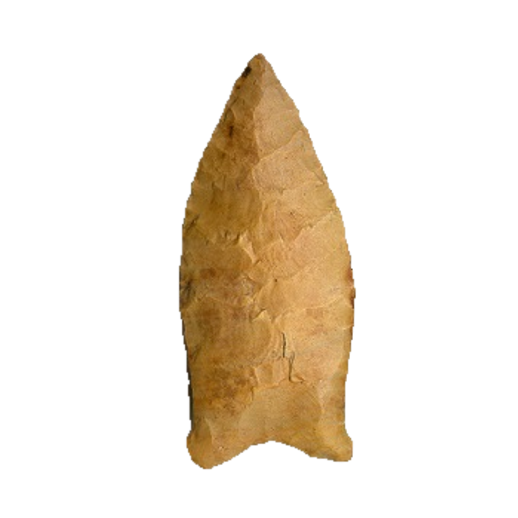
Arrowhead type
Quad Point
QuadDalton Cluster10,500 - 9,900 B.P.Transitional Paleo27 reference photos
Key facts
- Age
- 10,500 - 9,900 B.P.
- Cultural period
- Transitional Paleo
- Size
- Small to Medium
- Shape
- Auriculate to Lanceolate
- Material
- Limestone
- Glacial period
- Late Pleistocene to Early Holocene
More from the Paleo period
Description
This medium-sized auriculate point exhibits a distinctive morphology, characterized by a broad, elliptical cross-section that tapers to a thin profile. The blade's curvature is notable, with a recurvate shape that transitions to an excurvate segment approaching the hafting area, before becoming incurvate at the point of attachment. The hafting region itself is marked by a constricted waist, with downward-pointing auricles that contribute to the point's overall silhouette. The base of the point is concave, sometimes featuring thinning or short fluting. A defining feature of this point type is the proportional relationship between the base and the auricles, which collectively form the widest part of the point. Notably, the lower third of the point often displays evidence of grinding and smoothing, including the basal edge, which suggests a deliberate effort to refine the point's shape and functionality. The flaking pattern on this point can vary, ranging from random to collateral, reflecting the technological nuances of its manufacture.
Size
The dimensions of these arrowheads are characterized by a total length ranging from 35 to 86 mm, with a mean length of 57 mm. The blade width varies between 17 and 35 mm, averaging 23 mm. The basal width spans from 23 to 36 mm, while the average thickness is 7 mm. Additionally, the basal concavity measures between 3 and 7 mm.
Distribution
This type is mainly concentrated in the Tennessee River Valley region. It appears with decreased regularity in the Ohio River valley area. Occasional discoveries are made in Iowa, Minnesota, and Wisconsin, albeit rarely. It may also occur in other specified locations, though at a lower rate
Additional information
In the realm of Native American arrowhead typology, a particular point of interest exhibits distinct characteristics that set it apart from its counterparts. Notably, this point bears a resemblance to the Beaver Lake point, but with several key differences. Its shorter length, broader width, and thinner cross-sectional profile are immediately apparent, while the presence of more pronounced ears adds to its unique morphology.
The origins and evolutionary relationships of this point are the subject of ongoing debate among archaeologists. One theory posits that it occupies a transitional position between the earlier Clovis point and the later Dalton point, potentially representing a missing link in the developmental sequence of these iconic point styles. Alternatively, some researchers propose that this point may have evolved from the Simpson point, eventually giving rise to the Beaver Lake point. Another hypothesis suggests a different lineage, wherein this point is thought to have originated from the Cumberland point and subsequently evolved into the Beaver Lake point.
Regardless of its precise phylogenetic relationships, this point remains an important artifact in the study of Native American lithic technology. Its unique combination of traits offers valuable insights into the technological and cultural developments of the time, highlighting the complexity and diversity of prehistoric societies. Further research and analysis are necessary to fully elucidate the significance of this point and its position within the broader context of Native American archaeological history. By examining the characteristics and potential relationships of this point, scholars can continue to refine our understanding of the intricate and fascinating history of indigenous cultures in North America.
Identified by
- Named by
- Frank J. Soday
- Year
- 1954
- Type site
- Quad Site, Limestone County, Alabama
Similar types
Types that are easy to confuse with the Quad point.
- Candy Creek
- Cumberland
- Golondrina
- Hardaway Blade
- Pelican
- Simpson
Other types in the Dalton Cluster
- Beaver Lake
- Dalton
- Dalton Breckenridge
- Dalton Colbert
- Dalton Greenbrier
- Dalton Hemphill
- Dalton Hempstead
- Dalton Nuckolls
- Dalton Sloan
- Hardaway Dalton
- Hi-Lo