
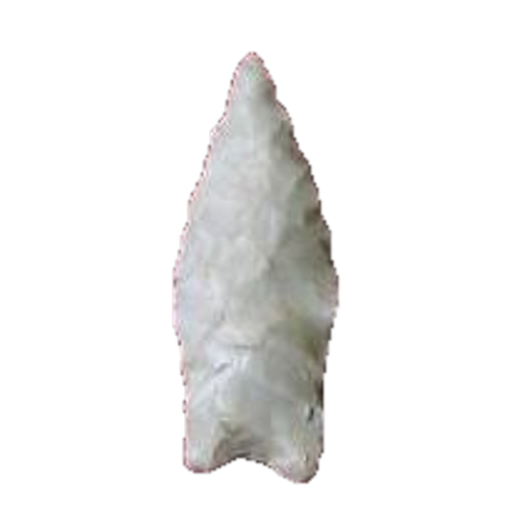
Arrowhead type
Dalton Hempstead Point
Dalton HempsteadDalton Cluster10,000 - 8,500 B.P.Transitional PaleoKey facts
- Age
- 10,000 - 8,500 B.P.
- Cultural period
- Transitional Paleo
- Size
- Medium to Large
- Shape
- Auriculate to Lanceolate
- Glacial period
- Early Holocene
More from the Paleo period
Description
This auriculate point exhibits a medium size profile, characterized by a blade cross-section that can vary from an elliptical shape to a more flattened form. The blade edge is generally straight, often featuring serrations and beveling. A distinctive constricted waist is present, which can result in shoulders and auricles that are either weakly defined or absent. The base of the point displays a range of concavity, from slight to deep. Evidence of grinding is visible on the hafting area, and both basal grinding and flaking are common features. In some cases, the basal flaking pattern may create an appearance reminiscent of fluting. The overall flaking pattern on the point can exhibit a range of styles, including oblique transverse, horizontal transverse, collateral, or random arrangements.
Size
The arrowheads exhibit dimensions ranging from 35 to 65 millimeters in overall length, with blade widths spanning 15 to 25 millimeters, as determined from a limited dataset.
Distribution
This type is located in Arkansas and extends into northern Louisiana.
Also found, less often, in
Additional information
In comparison to the quintessential Dalton point, this particular arrowhead exhibits a more compact morphology, characterized by a shorter length and narrower width. This distinction is notable, as the Dalton point is often regarded as a paradigmatic example of early Native American projectile technology, typically dating back to the Late Pleistocene era, around 10,000 to 12,000 years ago. The more diminutive proportions of this point suggest a potential variation in design or functional adaptation, warranting further examination and analysis to elucidate its significance within the context of Native American archaeological record.
Identified by
- Named by
- Gregory Perino
- Year
- 1991
Similar types
Types that are easy to confuse with the Dalton Hempstead point.
- Arkabutla
- Candy Creek
- Copena Articulated
- Golondrina
- Meserve
- Nolichucky
- Pelican
- Plainview
- San Patrice
Other types in the Dalton Cluster
- Beaver Lake
- Dalton
- Dalton Breckenridge
- Dalton Colbert
- Dalton Greenbrier
- Dalton Nuckolls
- Dalton Sloan
- Hardaway Dalton
- Hi-Lo
- Quad