
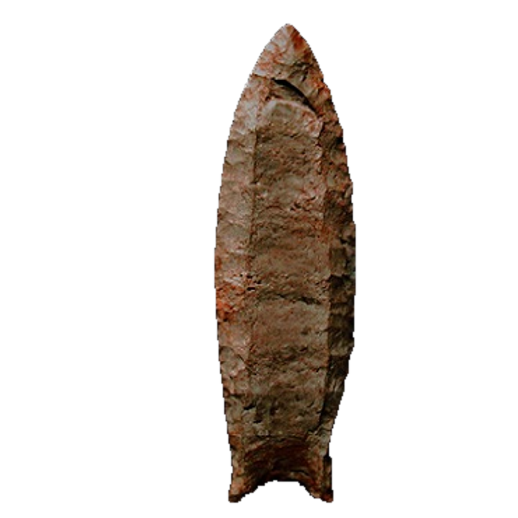
Arrowhead type
Barnes Point
BarnesCumberland Cluster11,000 - 9,000 B.P.Late Paleo4 reference photos
Key facts
- Age
- 11,000 - 9,000 B.P.
- Cultural period
- Late Paleo
- Culture
- Parkhill Complex
- Size
- Medium to Large
- Shape
- Auriculate
- Material
- Chert
- Glacial period
- Late Pleistocene to
More from the Paleo period
Description
This auriculate point exhibits a distinctive morphology, characterized by a medium to large size and a fluted profile. In cross-section, the area bearing the flute is compressed, transitioning to an elliptical shape above the flute. The blade's outline is marked by an outward recurvate curvature, resulting from a constricted waist that defines the hafting zone. A notable feature of this point is its "fishtail" silhouette, where the maximum width is typically situated just below the midpoint. From the waist, the blade broadens, forming auricular protrusions. The base of the point is concave and may display subtle grinding along the basal and lateral margins. A small, pressure-flaked scar is evident, created after the flute was established. The facial surface features one or more extended flakes or flutes, which span approximately half to three-quarters of the blade's length. The overall flaking pattern is noteworthy for its precise execution, exhibiting a parallel to collateral arrangement.
Size
The dimensions of the arrowheads are characterized by the following measurements: - Length ranges from 35 mm to 105 mm, with a mean length of 61.2 mm. - The width varies between 15 mm and 25 mm, averaging 21.5 mm. - Thickness spans from 3.5 mm to 8 mm, with a mean thickness of 5.7 mm. - The basal width is measured between 14 mm and 20 mm, with an average of 17.4 mm. - Basal concavity ranges from 2 mm to 6 mm, with a mean of 2.6 mm. - The width-to-thickness ratio falls within the range of 3:1 to 4.5:1.
Distribution
This projectile is mainly located in the Susquehanna and Hudson River basins and stretches into the Great Lakes area. Its range expands to southeastern Ontario and southern Quebec. This projectile appears in the Ohio River Valley, but with less regularity. This projectile has (Cumberland / Barnes) been documented in Ontario (49 instances), Quebec (3 instances), Nova Scotia (144), and Maine (6 instances) by the 2010 PIBDA. Nevertheless, these projectiles are seldom encountered in these regions and this coincides with the similar Debert point. These projectiles may signify variations of the Debert point
Additional information
The Barnes arrowhead type can be distinguished from its Cumberland counterpart through several notable characteristics, including the distinctive "Barnes Finishing" technique evident on its base. This technique, which involves a prominent median ridge and longer flutes that span approximately half to three-quarters of the face, sets it apart from the Cumberland type. Furthermore, the Barnes type exhibits a thinner cross-section, a trait that is not commonly observed in Cumberland arrowheads. The evolutionary timeline of these arrowhead types suggests that the Barnes type is slightly younger than the Cumberland type, with the latter potentially giving rise to the former in the eastern states.
The Barnes Finishing Flaking Technique, as described by Deller and Ellis (1988), involves a specific process of flaking that results in a deeper basal cavity. This is achieved through the removal of a single broad, short flake over the primary flute on both faces of the arrowhead, which in turn widens and thins the base. This unique technique is a hallmark of the Barnes type and has been used to identify and classify arrowheads found in various regions, including the Great Lakes area and Canada. The migration pattern of the Barnes type is thought to have originated in the eastern states, where it evolved from the Cumberland type, before spreading into the Great Lakes region and beyond.
The Barnes arrowhead type has been associated with the Parkhill Complex in Ontario, with Roosa (1963) suggesting that it is diagnostic of this particular complex. This assertion is based on the discovery of points at the Parkhill site that were classified as Barnes by Roosa. However, not all researchers agree with this assessment, proposing instead that the Parkhill points represent a distinct type that is separate from the Barnes classification. Despite this debate, the Barnes arrowhead type remains an important and intriguing area of study, offering valuable insights into the technological and cultural developments of Native American communities in the region.
Identified by
- Named by
- William Roosa
- Year
- 1963
- Type site
- Multiple sites in Michigan and into Ontario
Similar types
Types that are easy to confuse with the Barnes point.
- Beaver Lake
- Clovis
- Cumberland
- Debert
- Hazel
- Holcombe