
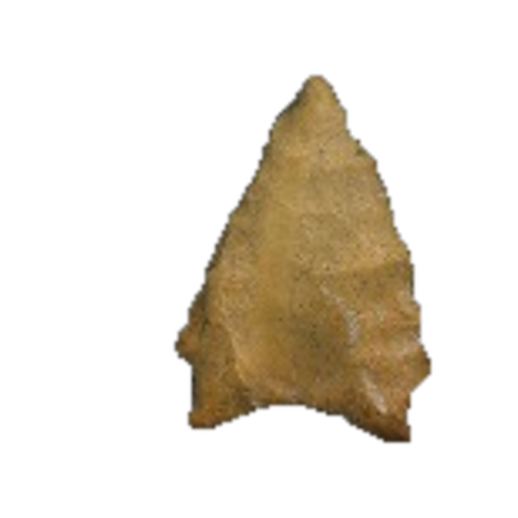
Arrowhead type
San Patrice Point
San PatriceSan Patrice Cluster10,000 - 8,000 B.P.Transitional Paleo to Early Archaic31 reference photos
Key facts
- Age
- 10,000 - 8,000 B.P.
- Cultural period
- Transitional Paleo to Early Archaic
- Size
- Small to Medium
- Shape
- Auriculate to Lanceolate to Side Notch to Corner Notch
- Glacial period
- Early Holocene
Description
This auriculate point exhibits a slender profile, typically measuring between 1 to 1.5 inches in length, with a cross-sectional shape that is notably flattened. The blade edge can display a range of curvature, from straight to excurvate. The shoulders of the point are variable, sometimes appearing weak or even absent, while in other instances, they are distinctly defined and angled upward. The stem expands outward, leading to a base that is characterized by a deep concavity, often forming pronounced auricles or "ears." The basal shape can vary, ranging from a deeply concave curve to a more angular V-shape. The base is thinned through the removal of two or three channel flakes, which can extend up the face of the point. Many examples of this point type exhibit basal grinding, a testament to the toolmaking techniques employed. The flaking pattern observed on this point is random, lacking a consistent or organized arrangement.
Size
The dimensions of the arrowheads are characterized by the following measurements: overall length ranges from 20 to 50 mm, with a mean length of 35 mm. The stem measures between 9 and 14 mm in length. The blade width varies from 20 to 32 mm, while the neck width spans 15 to 25 mm. Notably, the basal width is slightly narrower than the shoulders. Additionally, fluting is present, extending along 1/3 to 2/3 of the point's length, as described by Suhm and Krieger (1954).
Distribution
San Patrice points are predominantly clustered in the western Gulf Coast region (red) and gradually taper off in the eastern Gulf Coast area (yellow). These points are also documented in central Texas, particularly among St. Johns, Hope, and Rodgers Side Hollow (Brazo Fishtail) varieties (green). According to Hurst et al. (2009), Hope and St. John's variants have been found at the Hardwick site in Roosevelt County, New Mexico, which falls within the green zone
Additional information
More information needed.
Identified by
- Named by
- Clarence Webb
- Year
- 1943
Similar types
Types that are easy to confuse with the San Patrice point.
- Dalton
- Kisatchie
- Palmer
- Pelican
- Rodgers Side Hollow
- San Patrice Keithville
- San Patrice Geneill
- San Patrice Hope
- San Patrice Leaf River
- San Patrice St. Johns
Other types in the San Patrice Cluster
- Albany
- San Patrice Kisatchie