
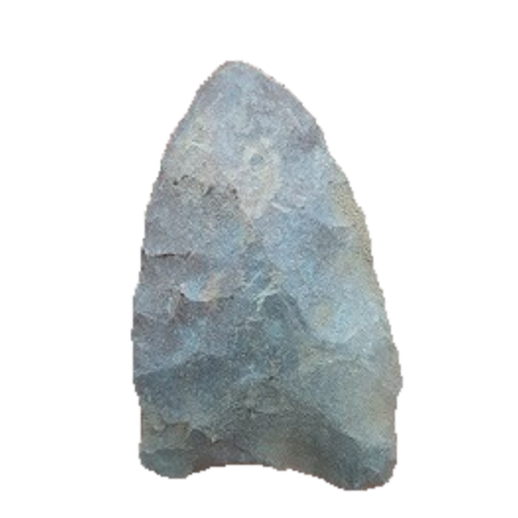
Arrowhead type
Hi - Lo Point
Hi - LoDalton Cluster10,500 - 10,000 B.P.Transitional Paleo19 reference photos
Key facts
- Age
- 10,500 - 10,000 B.P.
- Cultural period
- Transitional Paleo
- Size
- Small to Medium
- Shape
- Lanceolate
- Material
- Chert
- Glacial period
- Late Pleistocene
More from the Paleo period
Description
This lanceolate point exhibits a compact to moderate size profile. In cross-section, its shape can vary from an elliptical outline to a more pronounced plano-convex configuration. A distinctive twist may be present along the blade's length. The blade itself is characterized by an excurvate shape, with its maximum width occurring at the midpoint. The shoulders are either faint or entirely absent, while the waist is constricted, giving rise to a straight or slightly flared stem. This constriction can impart an eared or nascent side-notch appearance to the point. The base displays evidence of bifacial thinning through flaking, with a curvature that ranges from slightly concave to deeply concave. Notable features include extensive grinding on the base and hafting area, accompanied by basal thinning. Many specimens exhibit left-handed alternating edge beveling. The flaking pattern on this point ranges from finely controlled collateral flaking to a coarser, more parallel arrangement.
Size
The arrowheads exhibit a range of dimensions, with lengths spanning 26 to 65 mm, widths varying from 18 to 35 mm, and thicknesses measuring between 6 and 11 mm.
Distribution
This type is mainly concentrated in the Great Lakes area. It can also occasionally be discovered in eastern parts of Iowa and Minnesota, and sporadically as far as the Atlantic Coast.
Additional information
The chronological context of these arrowheads remains somewhat ambiguous, as none of the Hi-Lo sites have undergone radiocarbon dating. However, researchers have established a timeline based on their connection to the Dalton point, as well as the presence of distinctive characteristics such as basal grinding and occasional fluting. Additionally, the discovery of these points at sites located on glacial beach ridges, which are believed to be associated with caribou hunting, provides further insight into their age (Justice, 1987). This contextual information collectively contributes to our understanding of the temporal framework in which these points were crafted.
A notable aspect of these arrowheads is their versatility, which is inferred from their design and the extent of edge beveling and resharpening. It is likely that they served multiple purposes, including functions such as knives, butchering tools, and projectile points. The fact that many of these points exhibit heavy maintenance, as evidenced by their frequent resharpening, suggests that they were highly valued and utilized by their creators. This repeated resharpening has, in many cases, resulted in the transformation of the points' original morphology, often yielding short, stubby, and asymmetrical forms (Morrow, 2016). This phenomenon highlights the importance of considering the lifecycle of these artifacts, including their production, use, and maintenance, in order to gain a more comprehensive understanding of their role in the lives of their creators.
The combination of these factors - the points' association with caribou hunting, their versatile design, and the evidence of extensive maintenance - provides a nuanced perspective on the cultural and functional significance of these arrowheads. By examining the characteristics of these points, such as their basal grinding, fluting, and edge beveling, researchers can reconstruct the technological, social, and environmental contexts in which they were created and utilized. This, in turn, contributes to a deeper understanding of the lives and traditions of the people who crafted and used these artifacts, shedding light on the complex and dynamic relationships between human populations and their environments in the past.
Identified by
- Named by
- James E. Fitting
- Year
- 1963
- Type site
- Hi-Lo Gun Club Site, Ionia County, Michigan
Similar types
Types that are easy to confuse with the Hi - Lo point.