
Arrowhead type
Arkabutla Point
ArkabutlaPlano Lanceolate Cluster10,000 - 8,000 B.P.Transitional Paleo5 reference photos
Key facts
- Age
- 10,000 - 8,000 B.P.
- Cultural period
- Transitional Paleo
- Size
- Small to Medium
- Shape
- Auriculate
- Material
- Chert
- Glacial period
- Early Paleo
More from the Paleo period
Description
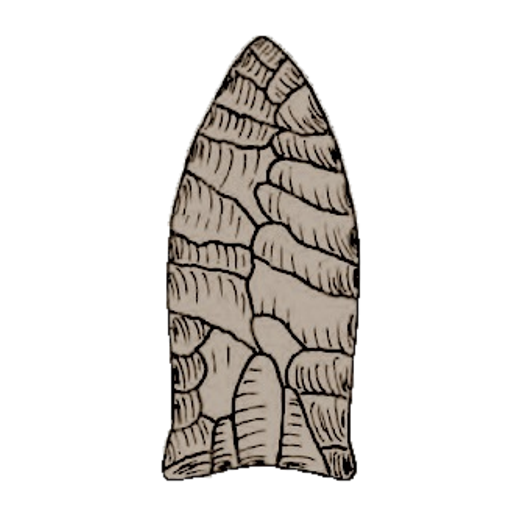
This lanceolate point, characterized by its slender profile and Auriculate morphology, exhibits a cross-sectional shape that transitions from flattened to elliptical. The recurvate blade form is marked by an inward curvature of the tip, while the edges converge to become parallel, creating a distinctive waist constriction that subsequently expands outward at the base. The basal auricles are subtly rounded, accompanied by a concave basal margin. The surface of this point displays a non-patterned, random flaking arrangement, indicative of a lack of deliberate flaking sequence.
Size
The dimensions of the arrowheads are characterized by the following measurements: overall length ranges from 35 to 65 mm, with a mean length of 47 mm. The blade width varies between 15 and 27 mm, averaging 25 mm. The waist width is typically 2 to 4 mm less than the blade width. In contrast, the basal width is 3 to 5 mm greater than the waist width. The thickness of the arrowheads falls within the range of 5 to 7 mm, with an average thickness of 6 mm.
Distribution
This type is mainly discovered in the central Mississippi River region and along the Red River Valley of northeast Texas.
Mainly found in
Also found, less often, in
Additional information
In the realm of Native American arrowhead typology, a distinct category bears a notable resemblance to the Quad type, albeit with a subtle yet significant difference. The primary distinguishing feature between these two types lies in the presence of more pronounced auriculates in the Quad type. This observation has led researchers to suggest that the subject type might be a variant of the Quad, as proposed by MaGahey in 2000. This potential classification underscores the complexities and nuances inherent in the study of arrowhead typology, highlighting the need for meticulous analysis and comparison to accurately categorize these ancient artifacts.
The similarity between these two types underscores the importance of careful examination and consideration of the morphological characteristics that define each category. The presence of less pronounced auriculates in the subject type, relative to the Quad, may indicate a subtle variation in the manufacturing techniques or stylistic preferences of the cultures that produced these arrowheads. Further research and analysis are necessary to fully elucidate the relationships between these types and to shed light on the cultural and historical contexts in which they were created.
The work of MaGahey (2000) provides a foundational framework for understanding the potential variant relationship between the subject type and the Quad type. By building upon this research and continuing to refine our understanding of Native American arrowhead typology, archaeologists can gain valuable insights into the technological, social, and cultural developments of the indigenous populations that crafted these artifacts. Ultimately, a more nuanced comprehension of these ancient tools can enrich our appreciation for the complexity and diversity of Native American cultures, while also informing our approaches to the study and interpretation of archaeological materials.
Identified by
- Named by
- Samuel O. MaGahey
- Year
- 1981
Similar types
Types that are easy to confuse with the Arkabutla point.