
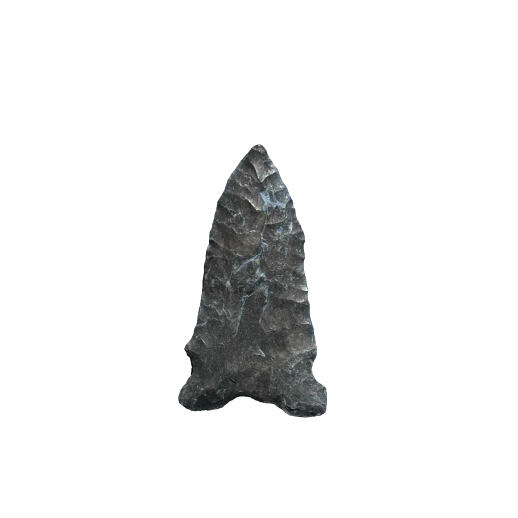
Arrowhead type
Dalton Nuckolls Point
Dalton NuckollsDalton Cluster10,000 - 8,500 B.P.Transitional Paleo to Early Archaic18 reference photos
Key facts
- Age
- 10,000 - 8,500 B.P.
- Cultural period
- Transitional Paleo to Early Archaic
- Size
- Medium to Large
- Shape
- Auriculate to Lanceolate
- Glacial period
- Early Holocene
Description
This medium-sized auriculate point exhibits a distinctive morphology, characterized by a cross-sectional profile that can be either elliptical or flattened. The blade itself is predominantly straight, often featuring serrations and beveling along its length. A notable characteristic of this point is the waist, which displays a subtle constriction, resulting in shoulders and auricles that may be weakly defined or even absent. The base of the point can exhibit a range of concavity, from slight to deep. The area intended for hafting often shows evidence of grinding, while the base may display both grinding and flaking, with some specimens exhibiting basal flaking that can create a fluted appearance. The flaking pattern on these points can be highly variable, encompassing oblique transverse, horizontal transverse, collateral, and random patterns.
Size
The dimensions of the arrowheads are characterized by a total length ranging from 40 to 120 mm, a width spanning 18 to 38 mm, and a basal concavity depth of 1 to 5 mm.
Distribution
This type is located in the upper Tennessee River region, extending into the Ohio River basin. It can also be discovered in western parts of Pennsylvania
Additional information
In the realm of Native American archaeology, a particular artifact has garnered attention for its potential classification as a re-sharpened Dalton Greenbrier point. Notably, this type of point has been documented in northern Florida, as reported by Bullen in 1975. However, the specimens cited by Bullen as Dalton Nuckolls have been characterized by their crude manufacture, prompting some scholars to express skepticism regarding their categorization as true Dalton points. Specifically, Farr's 2006 analysis has raised questions about the authenticity of these examples, highlighting the need for further examination and verification to confirm their typological status.
The Dalton Greenbrier point is a significant artifact in the context of Native American archaeology, and its presence in northern Florida underscores the complex and dynamic nature of prehistoric cultural exchange and migration patterns. The fact that some examples from this region exhibit crude workmanship may indicate a range of factors, including variations in craftsmanship, the availability of raw materials, or even the possibility of hybrid or experimental point styles. As such, a more nuanced understanding of these artifacts is essential for shedding light on the lives and traditions of the indigenous peoples who created them.
Further research and analysis are necessary to fully elucidate the characteristics and significance of the Dalton Greenbrier point in northern Florida. By examining the technological, stylistic, and cultural attributes of these artifacts, archaeologists can gain a deeper appreciation for the historical context in which they were produced and used. Ultimately, a more comprehensive understanding of these points will contribute to a richer and more detailed narrative of Native American cultural heritage, highlighting the diversity, adaptability, and ingenuity of the region's prehistoric inhabitants.
Identified by
- Named by
- Madeline Kneberg
- Type site
- Nuckolls Site, Humphrey County, Tennessee
Similar types
Types that are easy to confuse with the Dalton Nuckolls point.
- Arkabutla
- Barnes
- Candy Creek
- Copena Articulated
- Golondrina
- Meserve
- Nolichucky
- Pelican
- Plainview
- San Patrice
- Suwannee
- Wheeler Recurve
Other types in the Dalton Cluster
- Beaver Lake
- Dalton
- Dalton Breckenridge
- Dalton Colbert
- Dalton Greenbrier
- Dalton Hempstead
- Dalton Hemphill
- Dalton Sloan
- Hardaway Dalton
- Hi-Lo
- Quad