
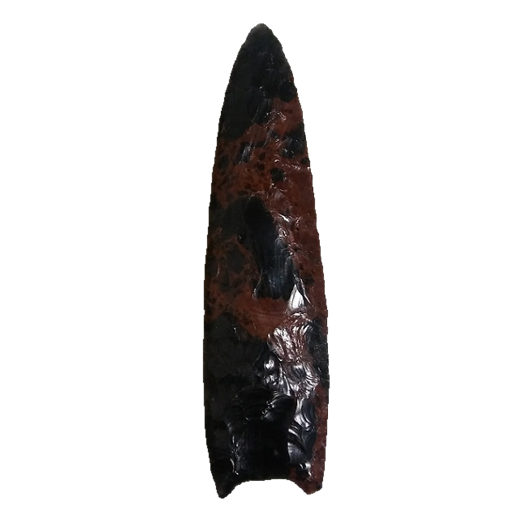
Arrowhead type
Clovis Fluted Point
Clovis FlutedClovis Cluster15,000 - 10,000 B.P.Paleo60 reference photos
Key facts
- Age
- 15,000 - 10,000 B.P.
- Cultural period
- Paleo
- Size
- Small to Medium to Large
- Shape
- Auriculate to Lanceolate
- Material
- Agate
- Glacial period
- Late Pleistocene
More from the Paleo period
Description
This triangular point exhibits a range of sizes, from small to large, and features a distinctive fluted design with a flattened cross-sectional profile. The blade's outline is characterized by an outward curvature that transitions from recurvate to excurvate, imparting a unique shape. The base of the point can display variability, sometimes presenting an auriculate form, while also potentially expanding or contracting, which may evoke the appearance of either an auriculate or lanceolate point. A notable feature of the base is its concave shape, accompanied by a flute that ascends from the base up the blade's face, often occurring on both faces, although single-face fluting is also observed. Typically, the flute extends upward between one-fifth to one-third of the point's face, frequently terminating in a step or hinge fracture. The hafting and basal areas exhibit medium to heavy grinding. The manufacturing process involved percussion flaking to shape and thin the blade, supplemented by pressure flaking to refine and trim the edges, resulting in a flaking pattern that spans from random to collateral or transverse flaking.
Size
length ranges from 45 mm to 150 mm, while width spans from 20 mm to 45 mm, indicating a considerable degree of size variation.
Distribution
This type has the densest populations across the Ohio, Tennessee, and Mississippi River valleys and the eastern part of the US (red). Numbers decrease in the Grasslands of areas in the US and Canada (dark pink). These points are seldom discovered west of the Continental Divide and in the Polar region of Canada and Alaska (light pink). This type is not documented in the coastal areas of Alaska and Canada possibly due to ancient water levels. This type is not documented in the glacial regions of Canada's interior
Mainly found in
- Alabama
- Arizona
- Arkansas
- California
- Colorado
- Connecticut
- Delaware
- Florida
- Georgia
- Idaho
- Illinois
- Indiana
- Iowa
- Kansas
- Kentucky
- Louisiana
- Maine
- Maryland
- Massachusetts
- Michigan
- Minnesota
- Mississippi
- Missouri
- Montana
- Nebraska
- Nevada
- New Hampshire
- New Jersey
- New Mexico
- New York
- North Carolina
- North Dakota
- Ohio
- Oklahoma
- Oregon
- Pennsylvania
- Rhode Island
- South Carolina
- South Dakota
- Tennessee
- Texas
- Utah
- Vermont
- Virginia
- Washington
- West Virginia
- Wisconsin
- Wyoming
- Alaska
- Canada
- Mexico
Additional information
In the realm of Paleo period archaeology, the term "Clovis point" is often broadly applied to fluted points, regardless of their geographical origin. However, a closer examination of these artifacts reveals subtle variations in shape that are correlated with specific regions. While some of these differences have been formally recognized and categorized into sub-types, others remain unnamed and await further classification. The taxonomy of Clovis-style points is a topic of ongoing debate among scholars, with some arguing that the shared characteristics of these points represent normal variability within the Clovis type, observable across their entire distribution.
Others propose that certain regions developed specialized forms of the Clovis point, which are found in greater frequencies in those areas. According to this perspective, these regional variants may be considered later adaptations or unique sub-types of the Clovis point, highlighting the dynamic and adaptive nature of Paleo period technologies. The existence of these regional variations underscores the complexity of Clovis point classification, emphasizing the need for continued research and refinement of our understanding of these ancient artifacts. By examining the subtle differences in shape and distribution, archaeologists can gain valuable insights into the cultural and technological developments of Paleo period societies.
The classification of Clovis points is further complicated by the fact that the same characteristics can be observed across different regions, making it challenging to distinguish between normal variation and distinct sub-types. Nevertheless, the study of these variations offers a unique window into the lives of Paleo period peoples, providing clues about their technological innovations, cultural exchange networks, and adaptive strategies. As our understanding of Clovis points and their regional variations continues to evolve, it is likely that new sub-types will be identified, and our appreciation for the complexity and diversity of Paleo period cultures will deepen. Ultimately, the ongoing debate surrounding Clovis point classification serves as a testament to the richness and complexity of Native American archaeological heritage.
Identified by
- Named by
- Edgar B. Howard
- Year
- 1935
- Type site
- Clovis Site, Blackwater Draw Locality, Curry County, New Mexico
Similar types
Types that are easy to confuse with the Clovis Fluted point.
- Agate Basin
- Angostura
- Alder
- Barber
- Bat Cave
- Belen
- Black Rock
- Barnes
- Beaver Lake
- Browns Valley
- Chipola
- Conerly
- Copena Articulated
- Crowfield
- Cumberland
- Dalton
- Golondrina
- Fayette
- Folsom
- Fredrick
- Lovell
- Midland
- Northumberland
- Red Stone
- Simpson
- Suwannee
- Union
- Withlacoochee
- Wheeler
Other types in the Clovis Cluster
- Anzick
- Clovis Colby
- Clovis Hazel
- Clovis St Louis
- Clovis Tulare
- Clovis Un-fluted
- Debert
- Holcombe
- Ross County